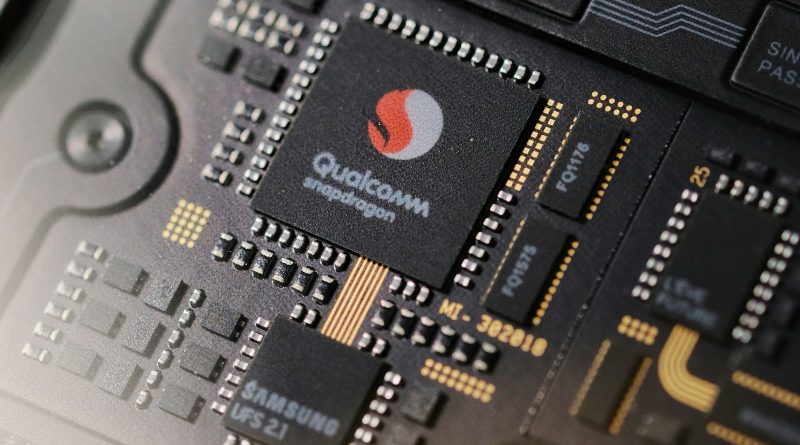
Qualcomm Snapdragon 8 Elite Gen 5: The 4.74 GHz Monolith That Outpaces Apple’s A19 Pro
By OFOKI TECH | August 27, 2026
Qualcomm announced the Snapdragon 8 Elite Gen 5 in September 2025. Eight months later, the chip has moved from press-release promise to silicon reality, powering the Samsung Galaxy S26 Ultra, the Galaxy Z Fold 8 series, and the Red Magic 11 Pro. What began as a specification sheet has now accumulated enough benchmark data and device deployments to be judged on merit rather than marketing. The verdict is unexpected: in multi-core workloads, Qualcomm’s flagship has pulled ahead of Apple’s A19 Pro. The gap is not large. But it is the first time in years that a Snapdragon chip has unambiguously beaten Apple’s best in a head-to-head throughput test.
The Architecture: 3nm, Monolithic, and Hungry
The Snapdragon 8 Elite Gen 5 is manufactured on TSMC’s N3P process, a refined 3nm node that offers better power efficiency than the base N3B used for earlier chips. It is a monolithic design — not a chiplet architecture like AMD’s Ryzen or Intel’s Arrow Lake — which means the CPU, GPU, NPU, and modem all sit on a single die. This reduces latency between components but makes the chip more expensive to produce, as a defect anywhere on the wafer can scrap the entire unit.
The die size and transistor count have not been disclosed, but the thermal envelope is telling. Devices equipped with the 8 Elite Gen 5, such as the Galaxy S26 Ultra, have adopted larger vapor chambers than their predecessors. The chip runs hot under sustained load, a trade-off Qualcomm seems willing to make for peak performance.
The CPU: Oryon Gen 3 and the 4.74 GHz Ceiling
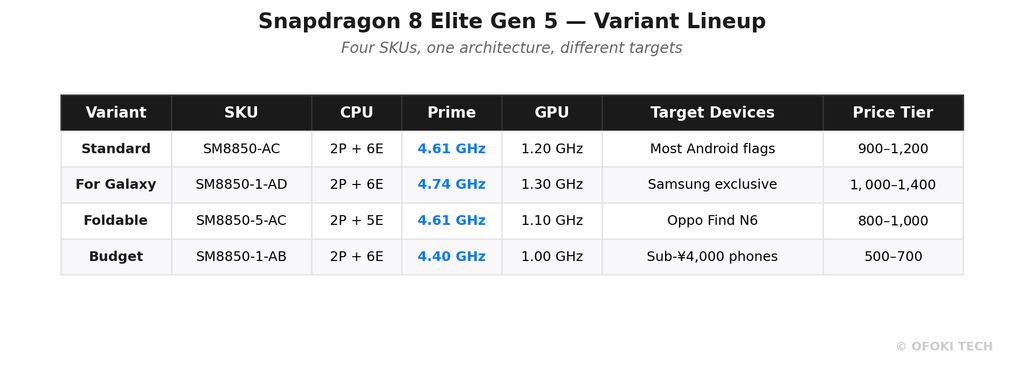
The CPU cluster is asymmetric: two Oryon Gen 3 Prime cores and six Oryon Gen 3 Performance cores. The Prime cores clock up to 4.61 GHz on the standard variant and 4.74 GHz on the « for Galaxy » version that Samsung uses in its flagships. The Performance cores top out at 3.63 GHz.
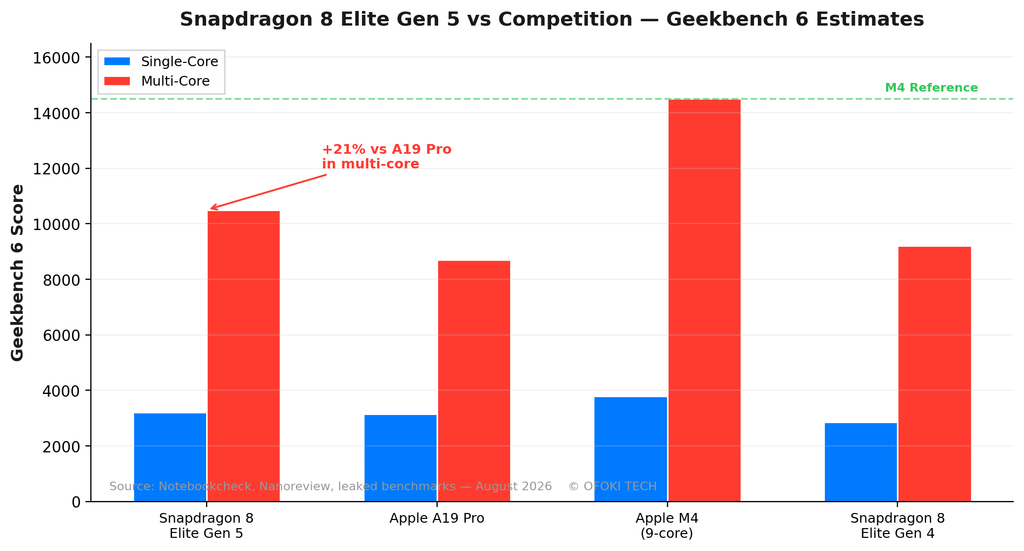
Notebookcheck’s benchmark database places the single-core performance of the Prime cores on par with the Apple A19 Pro. In multi-core tests, the 8 Elite Gen 5 outperforms the A19 Pro by approximately 21% and sits just behind a 9-core Apple M4, a chip designed for tablets and laptops rather than phones. That is a remarkable position for a smartphone SoC.
The instruction set is ARMv9.2-A, with 12 MB of L2 cache and 12 MB of L3 cache. The memory controller supports LPDDR5X-5300, delivering a maximum bandwidth of 84.8 GB/s across a quad-channel 64-bit bus. Maximum RAM capacity is 24 GB, though most current devices ship with 12 or 16 GB.
The GPU: Adreno 840 and the Sliced Architecture
The Adreno 840 GPU is clocked at 1.20 GHz, up from 1.10 GHz on the Adreno 830. It employs a « sliced » architecture introduced with the previous generation, with 18 MB of dedicated cache that Qualcomm markets as « Adreno High Performance Memory. » The chip supports Vulkan 1.4, OpenCL 3.0, and DirectX 12.1.
Qualcomm claims a 23% performance increase and 20% power reduction over the Adreno 830. The GPU also features out-of-the-box support for Unreal Engine 5, and Qualcomm has partnered with developers including Tencent to optimize titles for the platform. In practice, the Adreno 840 handles 4K 120 FPS video encoding and 1080p 480 FPS slow-motion capture, with support for still images up to 320 MP.
The NPU and AI: Hexagon at 37% Faster
The Hexagon NPU is the component Qualcomm is pushing hardest in its marketing, and for good reason. The AI workload is where smartphone differentiation now lives. The 8 Elite Gen 5’s NPU is 37% faster than the previous generation’s, with 16% better performance per watt. Qualcomm emphasizes « agentic AI » — on-device assistants that can take actions across apps without cloud dependency. The chip supports continuous on-device learning through a Personal Knowledge Graph and Personal Scribe, features that keep user data local rather than shipping it to a server.
The pitch is privacy-first AI. Whether developers will build for it is another question. Apple’s Neural Engine and Google’s Tensor G6 have their own on-device AI ecosystems, and Qualcomm’s challenge is not raw speed but software adoption.
The Variants: Four SKUs, One Strategy
The 8 Elite Gen 5 is not a single chip. It is a family of variants tailored to different price tiers and OEM requirements. The standard SM8850-AC powers most Android flagships. The SM8850-1-AD « for Galaxy » variant boosts CPU and GPU clocks by 100 MHz for Samsung’s exclusive use. The SM8850-5-AC is a seven-core version with one Performance core disabled, used in the Oppo Find N6 to manage thermals in a foldable form factor. And a cheaper SM8850-1-AB variant is reportedly in development for phones under 4,000 yuan.
Tempo.co reported the cheaper variant via leaker Digital Chat Station, indicating that Qualcomm is preparing to push its flagship architecture into the upper-mid-range segment. If accurate, this would blur the line between Qualcomm’s 8-series and 7-series chips, a move that could cannibalize the company’s own product stack but would strengthen its position against MediaTek’s Dimensity 9500.
The Devices: Who Is Using It
The Snapdragon 8 Elite Gen 5 is already deployed in several high-profile devices. The Samsung Galaxy S26 Ultra uses the « for Galaxy » variant. The Galaxy Z Fold 8 and Z Fold 8 Ultra use the standard SM8850-AC. The Red Magic 11 Pro, a gaming phone with active cooling, pushes the chip to its thermal limits. The Oppo Find N6 uses the seven-core variant.
What is notable is who is not using it. Google continues to use its own Tensor G6 in the Pixel 10 series. Apple, obviously, uses the A20 Pro. And some Chinese manufacturers, including Vivo and Xiaomi, have opted for MediaTek’s Dimensity 9500 in certain markets. The 8 Elite Gen 5 is the default choice for Android flagships, but it is no longer the only choice.
Verdict
The Snapdragon 8 Elite Gen 5 is the most technically impressive chip Qualcomm has ever shipped. It matches Apple in single-core performance, beats Apple in multi-core, and delivers GPU and NPU gains that are meaningful rather than incremental. The 3nm N3P process gives it a manufacturing edge, and the sliced Adreno 840 architecture is a genuine step forward for mobile graphics.
But the chip is not without compromises. It runs hot. It is expensive. And the proliferation of variants — standard, Galaxy, seven-core, and soon a cheaper model — suggests that Qualcomm is struggling to fit the same silicon into devices that range from $560 to $1,500. The « for Galaxy » variant, with its higher clocks, is essentially a factory-overclocked chip sold exclusively to Samsung, a practice that raises questions about whether standard-variant buyers are getting the full performance they paid for.
The larger question is whether raw performance still matters. Apple’s A19 Pro and Google’s Tensor G6 are slower in benchmarks but tightly integrated with their respective software ecosystems. Qualcomm’s chip is faster on paper, but Android’s fragmentation means that speed does not always translate to smoother real-world experience. The Snapdragon 8 Elite Gen 5 wins the spec sheet. Whether it wins the user experience depends on what Samsung, OnePlus, and Xiaomi do with it.
Sources and further reading
- Qualcomm Official: Snapdragon 8 Elite Gen 5 Press Release
- Qualcomm Official: Snapdragon 8 Elite Gen 5 Product Page
- Notebookcheck: Snapdragon 8 Elite Gen 5 for Galaxy Benchmarks
- Nanoreview: Snapdragon 8 Elite Gen 5 Specifications
- Tempo.co: Cheaper Snapdragon 8 Elite Gen 5 Variant
- iQOO Community: Snapdragon 8 Elite Gen 5 GPU and NPU Details