Apple « Surprise and Shine »: The September 9 Event That Fractures the iPhone Calendar Forever
By OFOKI TECH | August 27, 2026
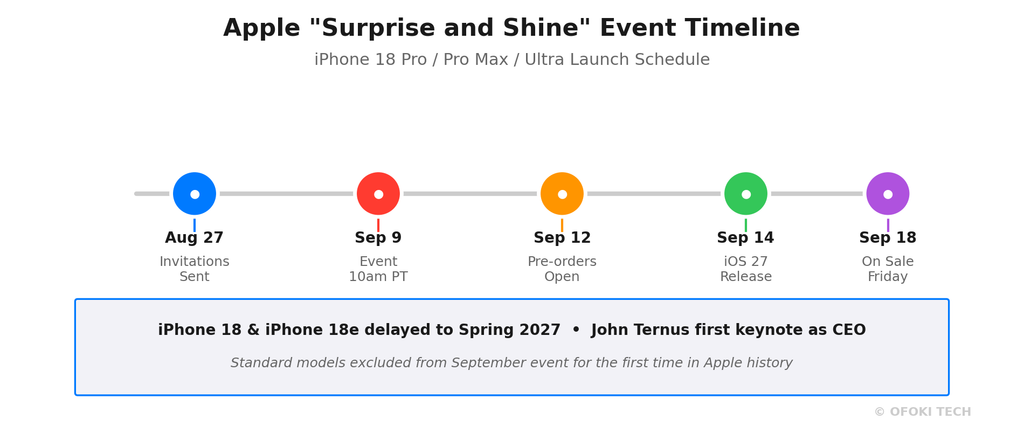
Apple sent the invitations on August 27, 2026. The tagline reads « Surprise and shine. » The event is confirmed for September 9 at 10 a.m. PT at the Steve Jobs Theater in Apple Park. For a company that has opened every September with a single, unified iPhone launch since 2012, this year’s keynote will be different. The standard iPhone 18 and the iPhone 18e are not invited. They have been pushed to spring 2027. What remains is a fall lineup composed entirely of devices priced at $999 and above — and a leadership transition that makes this John Ternus’s first keynote as CEO.
The Invitation: Neon, Siri, and a Tagline That Means More Than It Says
The promotional artwork shows the Apple logo rendered in a glowing neon effect, evoking the white neon glow of the Siri AI beta announced at WWDC 2026. Mashable, which received an invitation to the event, noted that the visual language ties the event directly to Apple’s AI push. The « shine » in the tagline is not decorative. It is a reference to the polished, agentic Siri experience that Apple has been building for two years and that will debut in full with iOS 27.
The event will be streamed live on Apple’s website, the Apple TV app, and YouTube. Members of the media have been invited to attend in person at Apple Park.
The Calendar: A Timeline With One Anomaly
The schedule is already locked in, and it contains one anomaly. Forbes’ David Phelan confirmed that pre-orders will open on Saturday, September 12 — not Friday, September 11. Apple has avoided September 11 for keynotes and pre-order dates since 2001. With September 11 falling on a Friday this year, the company shifted pre-orders to the following day, a break from tradition that has held for over a decade.
iOS 27 is expected to release on Monday, September 14. First reviews will appear on Wednesday, September 16. The iPhone 18 Pro, iPhone 18 Pro Max, and iPhone Ultra will go on sale Friday, September 18.
The Ternus Factor: A New CEO’s First Keynote
Tim Cook is scheduled to step aside as CEO on September 1, 2026, making way for John Ternus, Apple’s current Senior Vice President of Hardware Engineering. This will be Ternus’s first keynote, and the first time since 2011 that someone other than Cook opens a September iPhone event. The transition is not a surprise — it has been telegraphed for months — but the timing means Ternus will inherit a product cycle that is already fragmented. His ability to sell a $2,000+ foldable phone and a delayed standard lineup will define the early perception of his tenure.
The Split Launch: Pros in Fall, Everyone Else in Spring
The most significant structural change is the absence of the standard iPhone 18 and iPhone 18e from the September stage. MacRumors confirmed in its roundup that only the iPhone 18 Pro, iPhone 18 Pro Max, and the foldable iPhone Ultra will debut on September 9. The standard iPhone 18, the iPhone 18e, and a second-generation iPhone Air are targeted for March or April 2027.
This is the first time Apple has deliberately split its iPhone launch across two seasons. The reason, according to multiple reports, is component allocation. TSMC’s 2nm production capacity is constrained, and Apple is prioritizing its highest-margin devices for the fall window while the mass-market models wait for manufacturing lines to free up. It is also a response to RAM price inflation: by delaying the standard models, Apple avoids launching a $799 phone with downgraded specs into a market where component costs have tripled.
What the Pros Will Bring: A20, Variable Aperture, and a Shrinking Dynamic Island
The iPhone 18 Pro and Pro Max will run the A20 Pro chip, Apple’s first 2nm processor manufactured by TSMC. The A20 Pro promises performance and efficiency gains over the 3nm A19, though the real-world delta will depend on how well Apple manages thermals in a chassis that is reportedly growing slightly thicker — one leak suggests 9mm and approximately 240 grams for the Pro Max, up from 8.75mm on the iPhone 17 Pro Max.
The camera is getting a meaningful upgrade: a variable aperture lens for the main sensor, which would allow users to physically adjust the size of the lens opening to control light intake and depth of field. This is not computational bokeh. It is mechanical control, a first for the iPhone lineup. The Dynamic Island is also expected to shrink by roughly 35%, from 20.7mm to approximately 13.5mm, as Apple moves some Face ID components under the display.
Color options are expected to include Dark Cherry as the headline new shade, alongside Light Blue, Dark Gray, and Silver.
The Foldable Question: iPhone Ultra at $2,000+
The iPhone Ultra, Apple’s first foldable, is widely expected to share the stage with the Pro models. Nikkei reported that Apple has instructed suppliers to prepare for 10 million foldable units this year, an increase over earlier production forecasts. The device is rumored to feature a 7.8-inch inner display, a 5.5-inch cover screen, and a price between $2,000 and $2,500.
There is some uncertainty about the launch timing. While the foldable will almost certainly be announced on September 9, recent rumors suggest it may not ship until December due to limited early production. If true, Apple would be following the same playbook it used with the original AirPods and the Vision Pro: announce early, ship later, control the narrative.
What Is Not Known
Apple has not confirmed the split launch, the foldable pricing, or the Ternus keynote. The standard iPhone 18 and 18e could still appear in September if Apple secures unexpected 2nm capacity. The foldable could be delayed to 2027 entirely, though the volume of supply-chain reports makes that unlikely. And the variable aperture camera, while heavily leaked, has not been verified by Apple.
Verdict
The September 9 event is not just another iPhone launch. It is the end of the unified fall keynote that has defined Apple’s product cycle for fourteen years. By splitting the lineup, Apple is admitting that TSMC’s 2nm process cannot feed the entire product line simultaneously. It is admitting that RAM costs have forced the company to choose between margin and volume. And it is betting that a $999+ fall lineup — anchored by a $2,000 foldable — can carry the quarter without a mass-market model.
The risk is significant. Apple’s upgrade cycle is built on predictability. A spring launch for the standard model breaks that rhythm and asks buyers to wait six months for the phone they can afford. In the meantime, Samsung’s Galaxy S26 FE launches this week, and Google’s Pixel 10 is already on shelves. Apple is ceding the fall to its competitors in the mid-tier, a segment it has never willingly abandoned.
If the Pro models and the foldable deliver enough innovation to justify the premium, the strategy will look like disciplined margin management. If they do not, Apple will face its first holiday quarter in a decade without a new iPhone for the average buyer. That is a gamble — and it is John Ternus’s first roll of the dice.