Garmin Fenix 9: $999, Three Sizes, and the Pro Tier That Finally Includes 43mmOFFICIAL
By OFOKI TECH | August 28, 2026
Garmin announced the Fenix 9 and Fenix 9 Pro series on August 25, 2026, during its « Play Harder » livestream event. The lineup includes three sizes — 43mm, 47mm, and 51mm — with the Pro variant now available in all three for the first time. The standard Fenix 9 starts at $999.99. The Pro starts at $1,099.99. Solar charging and inReach satellite communication are available as tiered upgrades. After years of criticism for omitting a 43mm Pro option, Garmin has corrected that omission. Whether the rest of the upgrade justifies the price depends on how much you value battery life over breakthrough features.
The Lineup: Three Sizes, Four Tiers, Eighteen SKUs
Garmin’s Fenix 9 series is the most fragmented the company has ever launched. Garmin’s official press release confirms the full range: Fenix 9, Fenix 9 Pro, Fenix 9 Pro Solar, and Fenix 9 Pro with inReach. Each is available in 43mm, 47mm, and 51mm cases, except the Solar variant which skips the 43mm size.
The standard Fenix 9 uses an AMOLED display across all sizes, with a titanium rear cover and fiber-reinforced polymer case. The Pro adds a brighter screen, an LED flashlight with green and red modes, and a fully titanium case. The Pro Solar replaces the AMOLED with a memory-in-pixel (MIP) solar-charging display that extends battery life dramatically. The Pro inReach adds LTE cellular and satellite communication via Garmin’s Messenger app.
Pricing escalates quickly. The Fenix 9 43mm is $999.99. The Fenix 9 Pro 43mm is $1,099.99. Adding inReach pushes the 43mm Pro to $1,199.99. At the top end, the Fenix 9 Pro Solar with inReach in 51mm is $1,399.99. TechRadar’s live coverage published the full pricing breakdown during the event.
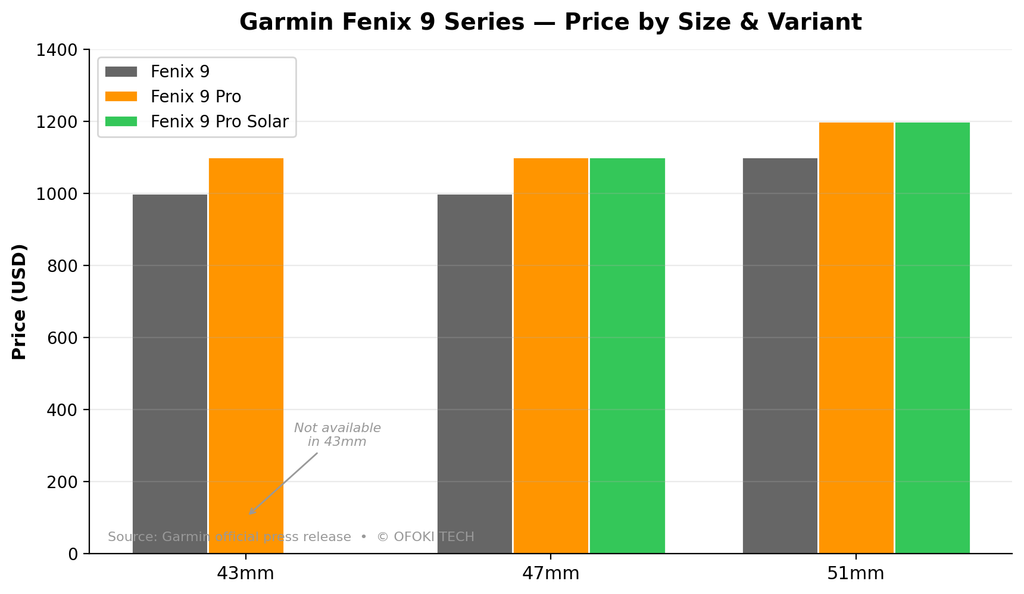
Figure 1: Garmin Fenix 9 series pricing by size and variant. Solar not available in 43mm. Source: Garmin official.
The Hardware: Brighter, Thinner, More Titanium
The Fenix 9 is thinner and lighter than the Fenix 8 despite using more premium materials. The standard model weighs 61g in 43mm and 75g in 47mm. The Pro is actually one gram lighter than the standard model in equivalent sizes, a result of the fully titanium construction replacing the polymer midsection.
All models feature sapphire crystal lenses, 10 ATM water resistance, and a dive rating to 40 meters. The display brightness has doubled compared to the Fenix 8 AMOLED, reaching approximately 2,000 nits on the Pro. Storage has doubled to 64 GB, enough for roughly 7,000 songs or detailed topographic maps.
The heart rate sensor remains the Garmin Elevate Gen 5, the same module used in the Fenix 8. There is no new Elevate Gen 6, despite rumors that Garmin might add blood pressure monitoring to match Apple and Google. Notebookcheck’s leak from August 25 confirmed the sensor arrangement is unchanged from the previous generation.
The Battery: Solar Changes Everything
Battery life is where the Fenix 9 justifies its premium. In 51mm, the standard Fenix 9 delivers up to 29 days in smartwatch mode. The Pro reaches 31 days. The Pro Solar, with sufficient sunlight exposure, extends to 57 days. In GPS mode, the gap is equally dramatic: 73 hours for the standard, 82 for the Pro, and 140 for the Pro Solar.
For ultrarunners, hikers, and multi-day adventurers, the Solar variant is the only choice. For urban athletes who charge weekly, the standard AMOLED is sufficient. Garmin’s decision to make Solar a Pro-tier exclusive — and to skip it in 43mm — suggests the company views solar as a niche feature for serious outdoor users rather than a mainstream necessity.
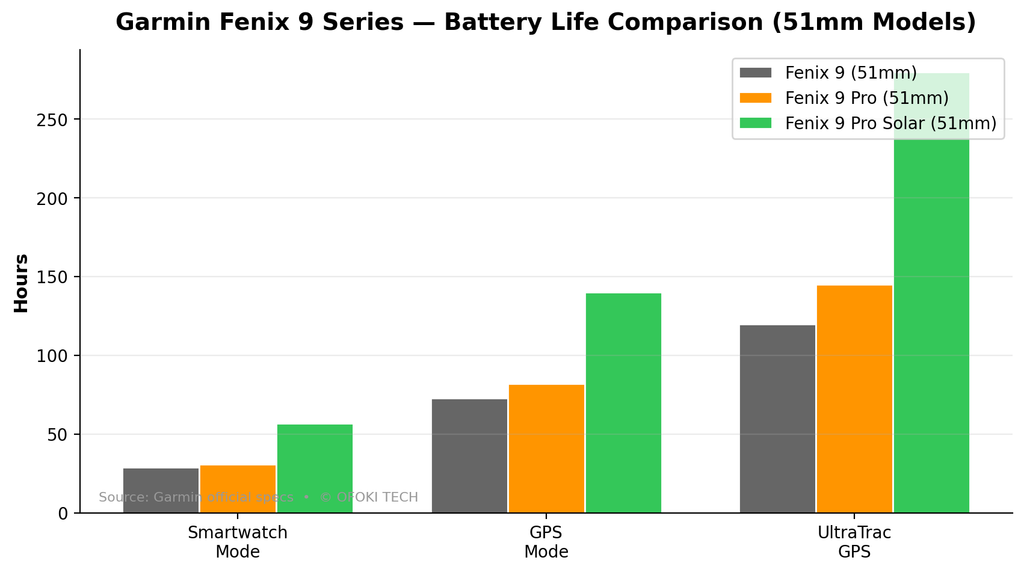
Figure 2: Battery life comparison across 51mm Fenix 9 variants. Solar assumes adequate sunlight exposure. Source: Garmin official specs.
The Software: Mapping, Epic, and ArcheryX
The Fenix 9 launches with a new mapping engine that Garmin claims is 30% faster at panning and 40% faster at round-trip routing than the Fenix 8. For runners and hikers who rely on turn-by-turn navigation, this is a meaningful quality-of-life improvement. The maps also support a new perspective view and more intuitive trail routing.
Garmin Epic is a new feature that groups multi-day activities into a single narrative, combining photos, health data, and performance highlights. It is designed for thru-hikers, bikepackers, and anyone who views their sport as a story rather than a collection of individual workouts.
ArcheryX replaces the previous Archery profile with real-time shooting timing and aiming indicators. A full indoor rowing performance suite has been added, including VO2 Max, FTP, power curves, and lactate threshold — all requiring a compatible rowing machine. Gaming Activity and GameOn app compatibility are also new, though their utility on a $1,000 fitness watch is questionable.
The 43mm Pro: The Correction Garmin Needed
The most significant change in the lineup is not a feature. It is the availability of the Pro tier in 43mm. The Fenix 8 Pro skipped 43mm entirely, forcing users with smaller wrists to choose between a too-large Pro or a standard model without the premium materials and flashlight. The criticism was loud and consistent.
Garmin has listened. The Fenix 9 Pro 43mm is $1,099.99 and includes the full titanium case, brighter AMOLED, and LED flashlight. It does not offer Solar — that remains exclusive to 47mm and 51mm — but the existence of a 43mm Pro at all is a response to customer demand that Garmin has resisted for two years.
What Is Not Known
Garmin has not released independent battery tests under real-world conditions. The 57-day Solar claim assumes optimal sunlight, which most users will not achieve. The long-term durability of the new mapping engine and the Elevate Gen 5 sensor’s accuracy during high-intensity activities have not been verified by third parties. Pricing for inReach subscriptions remains $7.99 per month, but Garmin has not confirmed whether this will change.
Verdict
The Garmin Fenix 9 is a refinement, not a revolution. It is thinner, brighter, and more expensive than the Fenix 8. The doubling of storage and display brightness are genuine improvements. The new mapping engine addresses one of the most common complaints about the previous generation. And the 43mm Pro corrects a product-line error that should never have existed.
But the Fenix 9 is also $999 at entry, with most buyers likely to spend $1,099 or more for the Pro. At that price, it competes with the Apple Watch Ultra 3 and Samsung’s Galaxy Watch 8 Pro. Garmin’s advantage remains battery life and outdoor durability. Its disadvantage remains smartwatch ecosystem — no cellular calls without inReach, no third-party app store to speak of, and a messaging system that requires the Garmin Messenger app rather than native SMS.
For the target audience — ultrarunners, mountaineers, triathletes — the Fenix 9 is the best tool available. For everyone else, it is overkill. Garmin knows this. The « Play Harder » tagline is not a suggestion. It is a filter. If you are not playing hard enough to need 57 days of battery, Garmin is happy to let Apple or Samsung take your money instead.