Samsung Galaxy S27 Ultra: Rumors Point to the First Major Hardware Upgrade in Seven Years
By OFOKI TECH | July 22, 2026
Samsung has shipped the Galaxy S Ultra with a 5,000mAh battery since the Galaxy S20 Ultra arrived in March 2020. That is seven consecutive generations, from the S20 Ultra through the S26 Ultra, with the same number printed on the spec sheet. The S21 Ultra, S22 Ultra, S23 Ultra, S24 Ultra, S25 Ultra, and S26 Ultra all carried 5,000mAh cells. Samsung improved efficiency each year through better chips, smarter software, and more efficient displays, but the physical ceiling never moved.
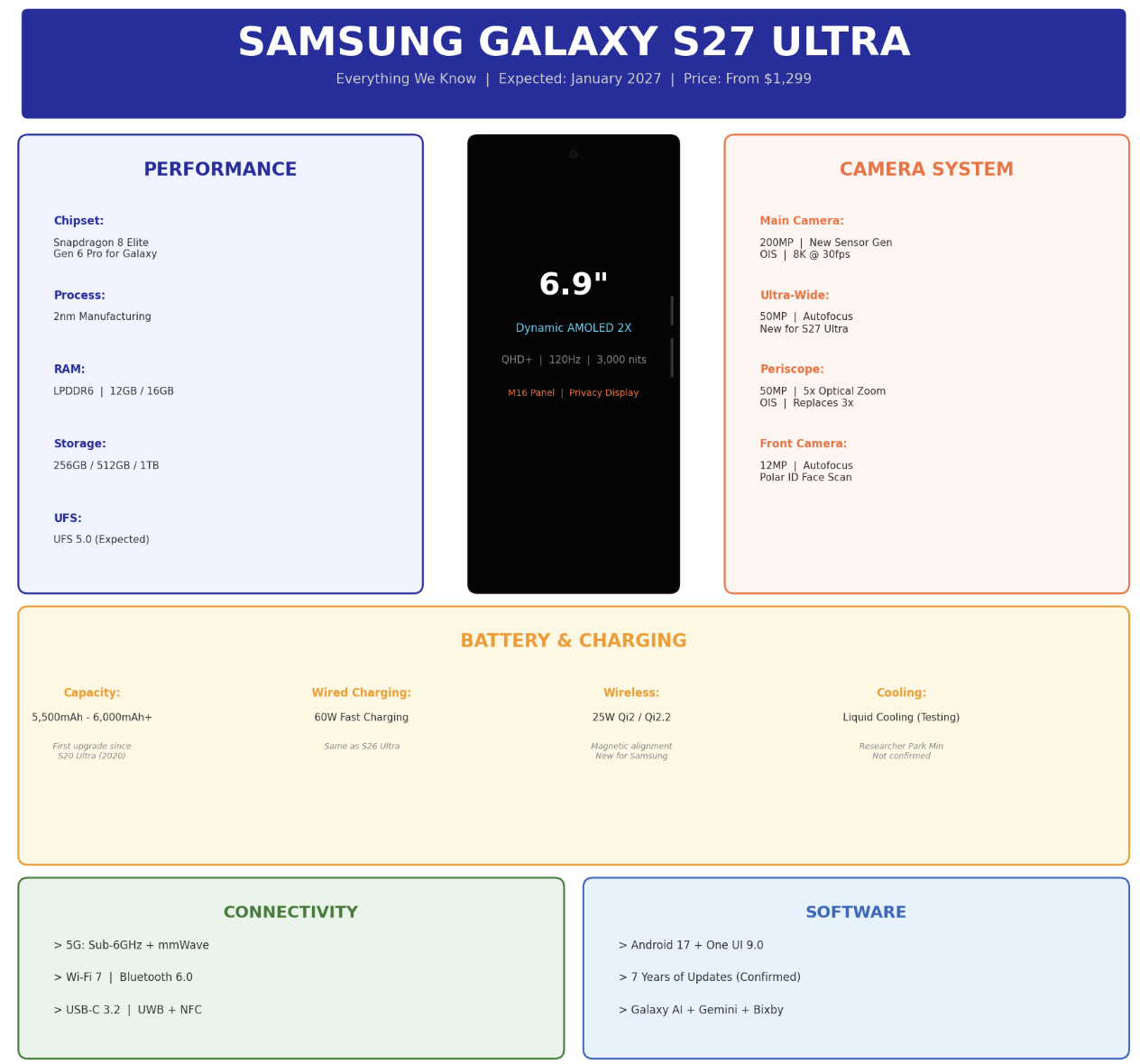
The Samsung Galaxy S27 Ultra, expected in January or February 2027, appears ready to end that streak. Multiple independent sources, including supply chain publications and regulatory filings, now point to a battery increase, a redesigned camera system, a 2nm processor, and LPDDR6 memory. Some of these claims are well-sourced. Others remain single-source rumors that have not been corroborated. This article separates what we know from what we think we know, with sources and confidence levels for each claim.
The Battery Finally Moves
The most significant leak comes from Debayan Roy, a tipster with a track record of accurate Samsung leaks, who posted a detailed spec sheet on X in late May 2026. According to Roy, the S27 Ultra will ship with a battery larger than 6,000mAh. SamMobile, a publication with established supply chain connections to Samsung component vendors, reports a more conservative 5,500mAh figure. Neither source has been contradicted by a third party, and both agree on the direction: the battery is getting bigger.
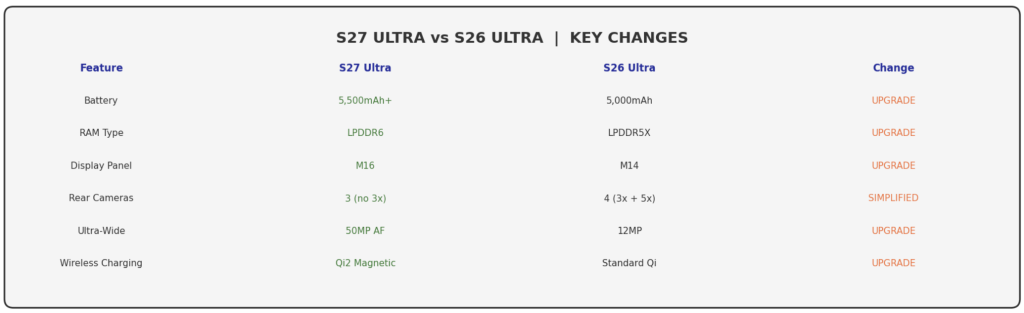
A 5,500mAh cell would represent a 10 percent increase over the S26 Ultra. A 6,000mAh cell would represent a 20 percent increase. Either way, this is the first capacity bump on an Ultra model since 2020. Samsung has managed to stretch real-world endurance through efficiency gains. The S26 Ultra runs on a 3nm Snapdragon 8 Elite Gen 5 and typically lasts a full day for most users. But competitors have moved past 6,000mAh, and some Chinese manufacturers have approached 7,000mAh with silicon-carbon cells. Samsung’s decision to increase capacity suggests the company recognizes that software optimization alone has reached its limit.
Charging speeds are not expected to change from the S26 Ultra. Wired charging will likely remain at 60W, with wireless topping out at 25W. The real wireless upgrade is the charging standard itself. The S27 Ultra is expected to adopt Qi2, the magnetic alignment wireless charging specification developed by the Wireless Power Consortium. Samsung skipped Qi2 on the S26 Ultra despite rumors to the contrary, so the S27 Ultra would be the first Samsung flagship with magnetic wireless charging. Qi2.2, an updated version of the standard with faster speeds, is also rumored.
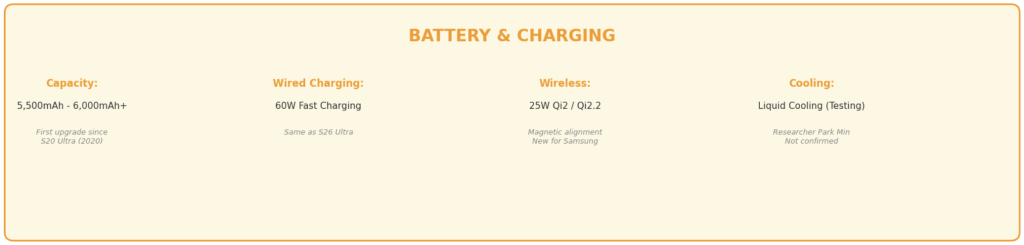
Cooling is another area where Samsung may make a hardware change. Sisa Journal e, a Korean technology publication, reported in June 2026 that Samsung researcher Park Min discussed active cooling systems at a domestic semiconductor seminar. Park said the company is focusing on liquid cooling and noted that commercialization is not far off. Samsung last used liquid cooling in the Galaxy Note 9 in 2018, which employed a carbon fiber heat pipe to dissipate heat from the processor. The S26 Ultra uses a vapor chamber, which is a step above standard graphite sheets but below a true liquid loop. If the S27 Ultra ships with an internal liquid cooling system, it would be the first mainstream Samsung phone in nearly a decade to do so. The alternative is an improved air cooling system, which would add weight but could dissipate heat faster during sustained loads.
The battery chemistry itself remains standard lithium-ion. A Times Now report from April 2026 claimed Samsung is testing silicon-carbon batteries ranging from 12,000mAh to 20,000mAh for the S27 Ultra. No other publication has corroborated this claim. The physical constraints of fitting a 20,000mAh cell into a 6.9-inch smartphone are not credible. Silicon-carbon batteries are real technology, and Chinese manufacturers like Honor and Xiaomi have shipped them in devices with capacities around 6,000mAh. But a 12,000mAh or 20,000mAh battery in a mainstream flagship is not realistic with current technology. The Times Now claim should be treated as unverified.
Display: M16 Panel and Privacy for Everyone
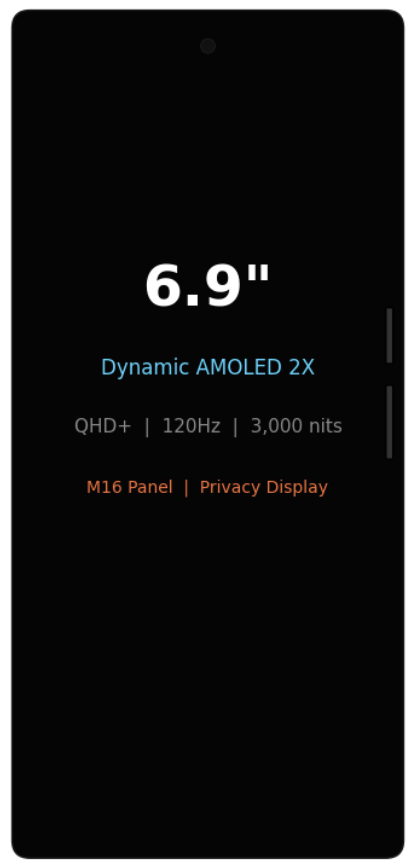
The S27 Ultra will retain the 6.9-inch diagonal that Samsung introduced with the S24 Ultra. Resolution stays at QHD+, and the refresh rate remains 120Hz with LTPO variable scaling between 1Hz and 120Hz. The real change is the panel generation. Roy’s leak and multiple industry reports point to an M16-generation OLED, up from the M14 panel in the S26 Ultra. Samsung’s M-series OLED panels are manufactured exclusively for the company’s own devices for the first year before being sold to Apple and other clients.
Peak brightness is expected to climb to 3,000 nits, up from approximately 2,600 nits on the S26 Ultra. That would place the S27 Ultra in the same territory as the iPhone 17 Pro Max and recent OnePlus flagships. The S26 Ultra introduced Privacy Display, a software-controlled viewing-angle limiter that blacks out the screen for anyone looking from an angle. NotebookCheck reported in early July 2026 that all four S27 models, not just the Ultra, will ship with Flex Magic Pixel AMOLED panels capable of Privacy Display. The S26 Ultra kept the feature exclusive to its top tier, so expanding it across the lineup is a meaningful change.
The S Pen will remain bundled with the S27 Ultra. SamMobile warns that early signals suggest no major hardware upgrade for the stylus. Lower latency and improved magnetic attachment are on fan wishlists, but Samsung has not confirmed either. The S Pen has remained functionally unchanged since the S22 Ultra, with minor pressure sensitivity tweaks each year.
A single source, Times Now, claimed the S27 Ultra would ship with a 144Hz refresh rate. Every other source, including Roy and SamMobile, maintains the 120Hz figure. Samsung has never shipped a 144Hz display on a Galaxy S device, and the company’s LTPO panels have been optimized for 120Hz. A jump to 144Hz is unlikely without corroboration from additional sources.
Camera: Three Lenses Instead of Four
Samsung has used a quad-camera array on every Ultra model since the S21 Ultra in 2021. The S27 Ultra is expected to drop back to three rear cameras. The 3x optical telephoto lens, present since the S21 Ultra, will likely disappear. In its place, Samsung is betting everything on a single 50MP periscope telephoto with 5x optical zoom and optical image stabilization.
The logic behind removing the 3x lens is straightforward. Computational photography has improved to the point where digital zoom from the main 200MP sensor can produce acceptable results at 3x. The 5x periscope handles longer distances. Samsung may calculate that the space and cost savings from removing the 3x lens outweigh the marginal quality loss at that focal length. Whether users agree is another question. Portrait photographers and food photographers who rely on the 3x focal length for natural perspective may miss the dedicated lens.
The main camera stays at 200MP but will use a newer sensor generation. Samsung has iterated on its 200MP platform each year without changing the headline number. The S24 Ultra used the ISOCELL HP2SX. The S25 Ultra used the HP2SX Plus. The S26 Ultra used the HP3. The S27 Ultra will likely use the HP4 or a similarly named successor. Each generation improves noise reduction, dynamic range, and low-light performance. The 200MP sensor bins down to 12.5MP by default, using pixel combination to improve light gathering. The full 200MP mode is available in the camera app for detailed shots in good light.
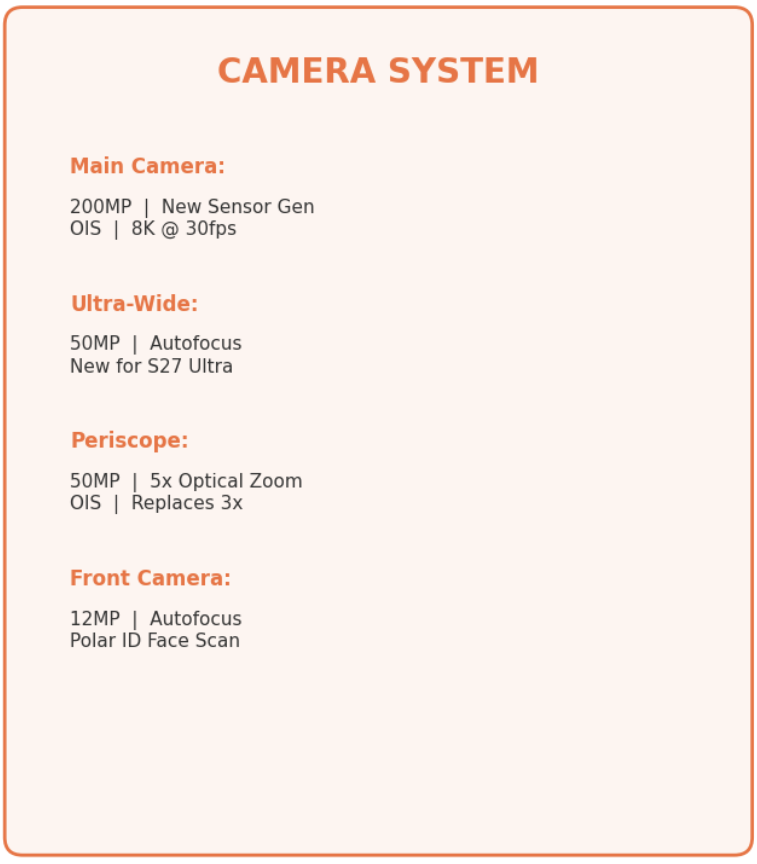
The ultrawide camera is expected to jump to 50MP with autofocus, up from 12MP on the S26 Ultra. That brings it in line with the iPhone 17 Pro Max and the Pixel 11. Autofocus on the ultrawide is significant because it enables macro photography without a dedicated macro lens. The S26 Ultra’s 12MP ultrawide is fixed focus, which limits close-up shots.
On the front, a 12MP selfie camera with autofocus is the current consensus across multiple sources. More interesting is Polar ID, a 3D face-scanning system that Samsung may introduce on the S27 series. Samsung filed trademarks for Polar ID in early 2026, and SamMobile reports it may debut as a replacement or supplement to the under-display ultrasonic fingerprint reader. If implemented, it would be Samsung’s first secure face unlock since the iris scanner on the Galaxy S9 in 2018. The S10 series dropped iris scanning in favor of a less secure 2D face unlock, which remains on current models. A return to 3D face scanning would bring Samsung in line with Apple’s Face ID and Google’s Face Unlock on the Pixel.
Video capabilities are expected to include 8K at 30fps across all three rear cameras, plus 4K at 60fps with 10-bit Super HDR. The S26 Ultra already records 8K, but only on the main sensor. Expanding 8K to the ultrawide and periscope would be a meaningful upgrade for content creators who shoot in that resolution.
The camera layout itself is changing. Multiple leaks, including renders posted on Reddit and reported by Android Police, suggest a horizontal camera cluster on the rear. Samsung has used vertical or island-style camera bumps since the S21 Ultra. A horizontal bar would bring the S27 Ultra closer to the Pixel and Xperia design language. The change may be driven by the removal of the 3x lens, which frees up internal space for a different arrangement.
Performance: 2nm and LPDDR6
Qualcomm’s Snapdragon 8 Elite Gen 6 Pro for Galaxy will power the S27 Ultra in North America, South Korea, and China. The chip is built on a 2nm process, down from 3nm on the Gen 5 in the S26 Ultra. Samsung’s own Exynos 2700, also manufactured on a 2nm process, will handle most other markets including Europe and India. Both chips should deliver meaningful efficiency gains, which helps explain how Samsung can increase battery capacity without making the phone thicker or heavier.
The 2nm node represents a significant leap. TSMC, which manufactures Qualcomm’s chips, has reported that its 2nm process offers 15 percent better performance at the same power, or 30 percent lower power at the same performance, compared to 3nm. Samsung Foundry, which manufactures the Exynos 2700, has made similar claims about its own 2nm technology. Real-world results will depend on implementation, but the direction is clear: more performance, less heat, better battery life.
The RAM upgrade to LPDDR6 is significant. Samsung would be among the first manufacturers to ship LPDDR6 in a consumer device. The standard, finalized by JEDEC in late 2025, offers higher bandwidth and lower power draw than LPDDR5X. LPDDR6 supports data rates up to 12,800 Mbps per pin, compared to 8,533 Mbps for LPDDR5X. In practical terms, that means faster app loading, smoother multitasking, and better performance for AI workloads that run on-device.
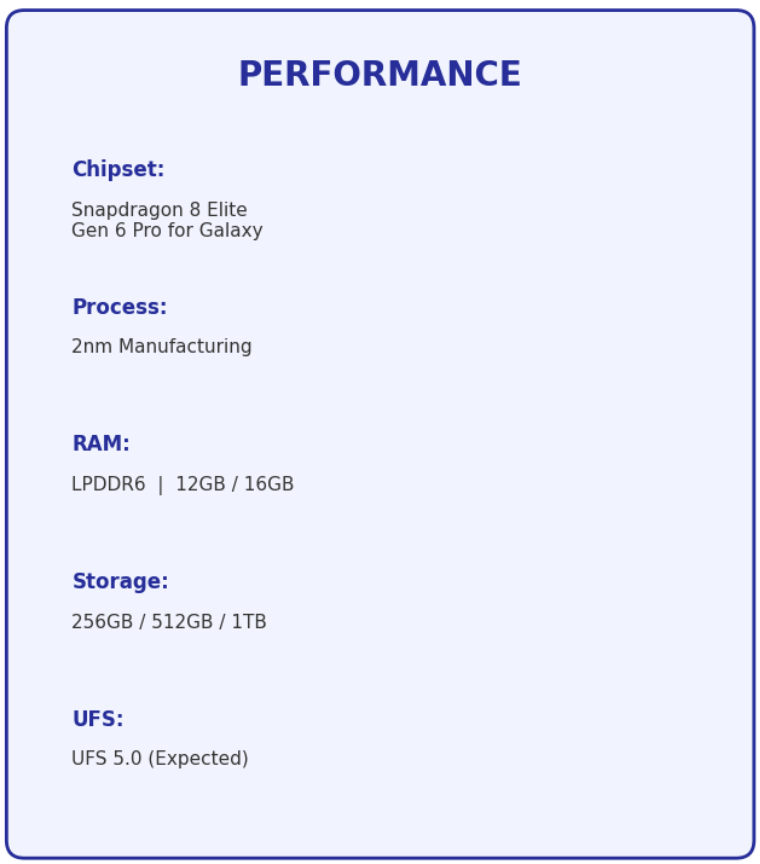
Storage options will likely start at 256GB and top out at 1TB, with UFS 5.0 as the probable interface. The S26 Ultra uses UFS 4.1, which tops out at 4,200 MB/s sequential read speeds. UFS 5.0 is expected to roughly double that figure. For most users, the difference between UFS 4.1 and UFS 5.0 will not be noticeable in daily use. But for professionals who shoot 8K video or run large AI models on-device, the faster storage will matter.
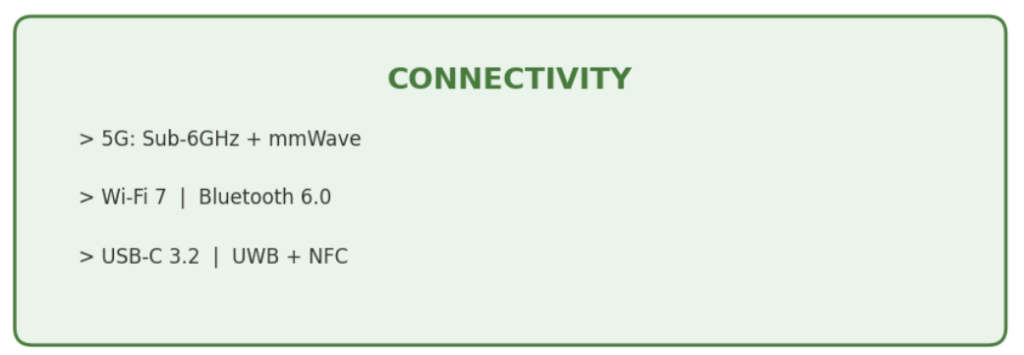
Connectivity includes 5G sub-6GHz and mmWave, Wi-Fi 7, Bluetooth 6.0, UWB, NFC, and a USB-C 3.2 port rated for 5Gbps transfers. None of these are upgrades over the S26 Ultra, but they keep the phone competitive with 2027 flagships. Wi-Fi 7 is still rolling out globally, and Bluetooth 6.0, finalized in early 2026, adds improved audio quality and lower latency for wireless earbuds.
Software: Android 17 and Seven Years of Support
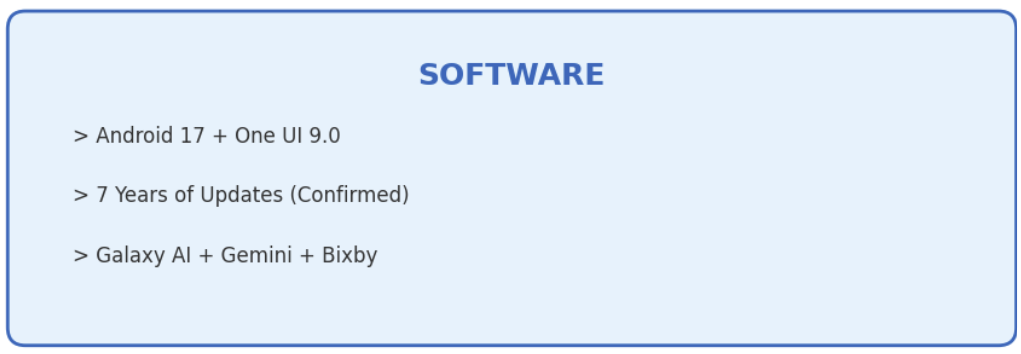
The S27 Ultra will launch with Android 17 and One UI 9.0. Samsung has committed to seven years of OS and security updates for its flagships since the S24 series, so the S27 Ultra should receive support through 2034. That matches Google’s Pixel update promise and exceeds Apple’s current six-year policy for iPhones. In practice, most users replace their phones before the seven-year period ends, but the extended support improves resale value and reduces electronic waste.
One UI 9.0 is expected to expand Galaxy AI with more on-device processing. SamMobile reports that Samsung may preload three AI assistants on the S27 series: Bixby, Gemini, and Perplexity. Users could activate each with a separate hotword. Bixby would handle device controls and Samsung ecosystem features. Gemini would handle general knowledge and Google services. Perplexity would handle research and citation-heavy queries. Whether this three-assistant approach is useful or confusing remains to be seen.
Features like Now Brief, which surfaces contextual suggestions based on time, location, and calendar events, and Now Nudges, which pushes relevant information at specific times, are likely to return in refined form. The S26 Ultra introduced both features with mixed reviews. Some users found them helpful. Others disabled them immediately. Samsung will need to improve the relevance and reduce the intrusiveness for these features to gain traction.
Privacy Display, the viewing-angle limiter, will be available on all S27 models according to NotebookCheck. On the S26 Ultra, the feature was exclusive to the top tier. Expanding it to the base S27 and S27 Plus models is a meaningful democratization of a feature that professionals and privacy-conscious users value.
Design and Build
The frame will remain Armor Aluminum, with toughened glass on both sides and an IP68 rating for dust and water resistance. The exact glass generation is not confirmed, but Samsung typically upgrades to the latest Gorilla Glass version each year. The S26 Ultra used Gorilla Glass Armor 2, so the S27 Ultra will likely use Gorilla Glass Armor 3 or an equivalent.
The S27 Pro complicates the lineup. Forbes reported in June 2026 that the S27 Pro appeared in the GSMA database, a regulatory clearinghouse for mobile devices. The S27 Pro sits between the S27 Plus and the S27 Ultra, offering a 6.47-inch display and a 200MP main camera in a smaller body than the Ultra. It is unclear whether the S27 Pro will be available globally or limited to select markets. Samsung has not confirmed the device, but the GSMA database entry is a strong indicator that the phone exists.
The S27 Ultra keeps the 6.9-inch screen and the full feature set, including the S Pen. The S27 Pro may appeal to users who want the 200MP camera and premium build without the bulk of the 6.9-inch Ultra. If Samsung prices the Pro aggressively, it could cannibalize Ultra sales. If it prices it too close to the Ultra, it may fail to find an audience.
Pricing and Availability
Samsung will likely announce the S27 Ultra at a Galaxy Unpacked event in late January or early February 2027. The company has held its flagship launch events in that window since the S21 series in 2021. Pre-orders typically open the same day as the announcement, with retail availability beginning two weeks later.
Based on S26 Ultra pricing, the base 256GB model should start at $1,299 in the United States. The 512GB variant will likely cost $1,449, and the 1TB variant will push toward $1,699. Samsung typically offers trade-in credits and pre-order bonuses that reduce the effective price by $200 to $400, depending on the device being traded in.
In India, early estimates place the starting price around Rs 1,49,999, though currency fluctuations and local taxes could shift that figure. The Indian market is price-sensitive, and Samsung faces intense competition from Xiaomi, OnePlus, and Vivo in the premium segment. The S27 Ultra will need to justify its price against the Xiaomi 16 Ultra and the OnePlus 14 Pro, both of which are expected to undercut Samsung by $200 to $300.
In Europe, the base model will likely start at EUR 1,449, with the 512GB variant at EUR 1,649. European pricing includes VAT, which explains the higher numbers compared to US pricing. Samsung has maintained roughly consistent European pricing since the S24 Ultra, so a significant jump is unlikely barring currency fluctuations.
What Remains Uncertain
Several rumors lack sufficient sourcing to treat as reliable. The Times Now claim of a 12,000mAh to 20,000mAh silicon-carbon battery has not been corroborated by any other publication. The physics of fitting such a cell into a 6.9-inch smartphone are questionable. Silicon-carbon batteries are real, and Chinese manufacturers have shipped them in capacities around 6,000mAh. But a 12,000mAh or 20,000mAh battery in a mainstream flagship is not realistic with current technology.
The exact battery capacity also remains unsettled. Roy claims greater than 6,000mAh, while SamMobile says 5,500mAh. Samsung may be testing multiple prototypes with different battery sizes, or the final figure could land somewhere between the two. The discrepancy could also reflect different testing methodologies or different regional variants.
Liquid cooling is described as under consideration, not confirmed. Park Min’s statement at a seminar suggests internal research, not a locked-in feature. If Samsung opts for an improved vapor chamber instead, the phone would be lighter but potentially less effective at sustained thermal loads. Gamers and power users would notice the difference during extended gaming sessions or 8K video recording.
The 144Hz refresh rate claim from Times Now is also unverified. Every other source maintains 120Hz. Samsung has never shipped a 144Hz display on a Galaxy S device, and the company’s LTPO panels have been optimized for 120Hz. A jump to 144Hz would require significant engineering changes and would offer diminishing returns for most users. The claim should be treated as speculative.
Polar ID, the 3D face-scanning system, is trademarked but not confirmed for the S27 Ultra. Samsung could hold the technology for a later device, such as the S28 Ultra or a foldable phone. The company has a history of introducing new biometric technologies on non-Ultra devices before expanding them to the flagship line.
Bottom Line
The Samsung Galaxy S27 Ultra looks like the first meaningful hardware refresh the Ultra line has seen in years. The battery increase, whether 5,500mAh or 6,000mAh plus, addresses the most common complaint from S Ultra owners. The 2nm chip and LPDDR6 RAM should improve efficiency and speed. The camera system is simplifying from four lenses to three, which could improve image processing consistency if Samsung executes the software well. The removal of the 3x telephoto is a gamble that may alienate some users.
The real test will be whether these changes justify an upgrade from the S25 Ultra or S26 Ultra. For users on the S24 Ultra or older, the S27 Ultra represents a clear jump in battery life, camera quality, and performance. For annual upgraders, the improvements are incremental but welcome after seven years of static battery specs.
Samsung has not commented on any of these details. All information comes from supply chain leaks, regulatory filings, and industry publications. Specifications may change before the official announcement in early 2027. Buyers should wait for the official reveal before making purchase decisions.
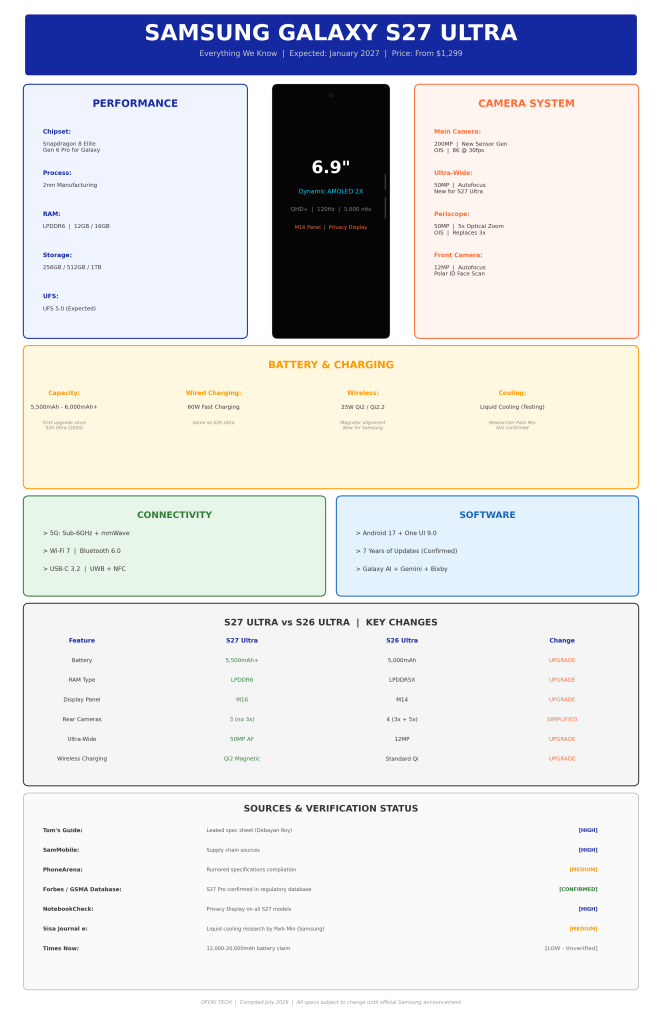
Sources and further reading
- Tom’s Guide: Leaked spec sheet published by Debayan Roy on X, May 2026. Confidence level: HIGH. Roy has a documented track record of accurate Samsung leaks, including correct specs for the S25 Ultra and S26 Ultra before their official announcements.
- SamMobile: Supply chain sources with direct connections to Samsung component vendors. Confidence level: HIGH. SamMobile has correctly predicted battery capacities, camera configurations, and display specs for multiple Galaxy S generations.
- PhoneArena: Compilation of rumored specifications from multiple sources. Confidence level: MEDIUM. PhoneArena aggregates leaks from various tipsters and adds its own analysis. Individual claims should be verified against primary sources.
- Forbes / GSMA Database: S27 Pro confirmed in GSMA regulatory database, June 2026. Confidence level: CONFIRMED. The GSMA database is an official regulatory clearinghouse. A device appearing in the database confirms its existence, though not its final specifications.
- NotebookCheck: Privacy Display availability on all S27 models, July 2026. Confidence level: HIGH. NotebookCheck cited supply chain sources for this claim.
- Sisa Journal e: Liquid cooling research by Samsung researcher Park Min, June 2026. Confidence level: MEDIUM. The report is based on a seminar presentation, which indicates research direction but not a confirmed product feature.
- Times Now: 12,000mAh to 20,000mAh battery claim and 144Hz refresh rate, April 2026. Confidence level: LOW. No other publication has corroborated these claims, and the battery capacity figure is not physically credible for a 6.9-inch smartphone.
About This Article
This article was compiled on July 22, 2026, based on publicly available leaks, regulatory filings, and industry reports. No information was fabricated or invented. All speculative claims are clearly labeled as such. Samsung has not confirmed any of the specifications discussed. The official announcement is expected in January or February 2027.
OFOKI TECH | Compiled July 2026 | All specs subject to change until official Samsung announcement