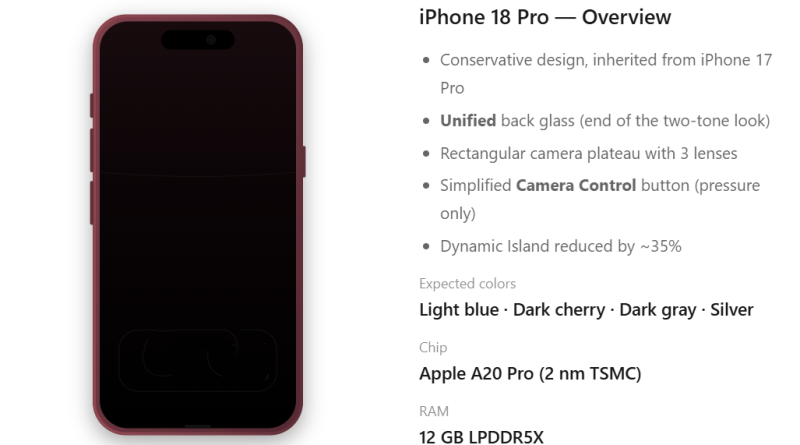
iPhone 18 Pro: What the Rumors Actually Say
By OFOKI TECH | July 24, 2026
Apple has not announced the iPhone 18 Pro. The device does not exist in any official capacity. But the volume of leaks, supply-chain reports, and analyst forecasts surrounding the phone is now substantial enough to assemble a credible picture of what Apple may unveil in September 2026.
This article breaks down what the rumors claim the iPhone 18 Pro offers, what the leaks say it does not offer, and how the device may position itself against Samsung’s Galaxy S27 Ultra and Google’s Pixel 10 Pro.
The Release Schedule: A Split Launch
The most significant structural change to the iPhone 18 lineup is not a hardware feature. It is the release timeline.
Bloomberg’s Mark Gurman and multiple other sources report that Apple will split the iPhone 18 launch into two events. The iPhone 18 Pro, iPhone 18 Pro Max, and the rumored foldable iPhone (referred to as either iPhone Fold or iPhone Ultra) are expected in September 2026. The standard iPhone 18, the iPhone 18e, and a second-generation iPhone Air are reportedly pushed to spring 2027, most likely March or April.
The reasoning, according to Gurman, is manufacturing complexity around the foldable display and the new 2nm chip, combined with Apple’s desire to give its premium hardware the full holiday spotlight without a cheaper model drawing attention away.
For buyers, this means the standard iPhone 18 will not be available in 2026. If you want a new iPhone this fall, the Pro models are the only option.
The Chip: Why 2nm Matters
The iPhone 18 Pro is expected to use Apple’s A20 Pro chip, built on TSMC’s 2-nanometer process. The current A19 chip is built on a 3-nanometer process. The move to 2nm is a long-awaited step down in node size that should deliver performance and efficiency improvements, leading to increased battery life without compromising speed.
The A20 Pro is expected to be exclusive to the Pro models and the foldable iPhone. The standard iPhone 18 and iPhone 18e are rumored to use the base A20 chip, a distinction Apple has maintained for several generations.
One report from a YouTube analysis channel suggests the A20 chip uses a new Wafer-Level Multi-Chip Module architecture. This has not been confirmed by other sources and should be treated as unverified.
RAM: 12GB for Pro, 9GB for Standard
The iPhone 18 Pro is widely expected to retain 12GB of RAM, the same as the iPhone 17 Pro. The standard iPhone 18 and iPhone 18e are now rumored to receive 9GB of RAM, an increase from the 8GB in the iPhone 17 but short of the 12GB some earlier reports predicted.
This matters for on-device AI. This matters for on-device AI. Some analysts, including Ming-Chi Kuo, believe future Apple Intelligence features may benefit from additional RAM, although Apple has not published official hardware requirements. If the standard iPhone 18 ships with 9GB of RAM while the Pro models retain 12GB, some advanced on-device AI features could remain exclusive to the higher-end models. If the standard iPhone 18 is limited to 9GB, those features will not be available on the base model. They will run on the Pro models and the foldable iPhone.
The Display: LTPO+ and a Smaller Dynamic Island
The iPhone 18 Pro is expected to retain the same 6.3-inch display size as the iPhone 17 Pro, with the Pro Max keeping its 6.9-inch panel. Both are rumored to use LTPO+ OLED technology at 120Hz ProMotion.
The more notable display change is a smaller Dynamic Island. Multiple leakers, including Ice Universe, claim the Dynamic Island will shrink by roughly 35% on the Pro models. This is achieved by moving some Face ID components under the display. Some reports suggest this smaller Dynamic Island could extend to the standard iPhone 18 as well, though this is less certain.
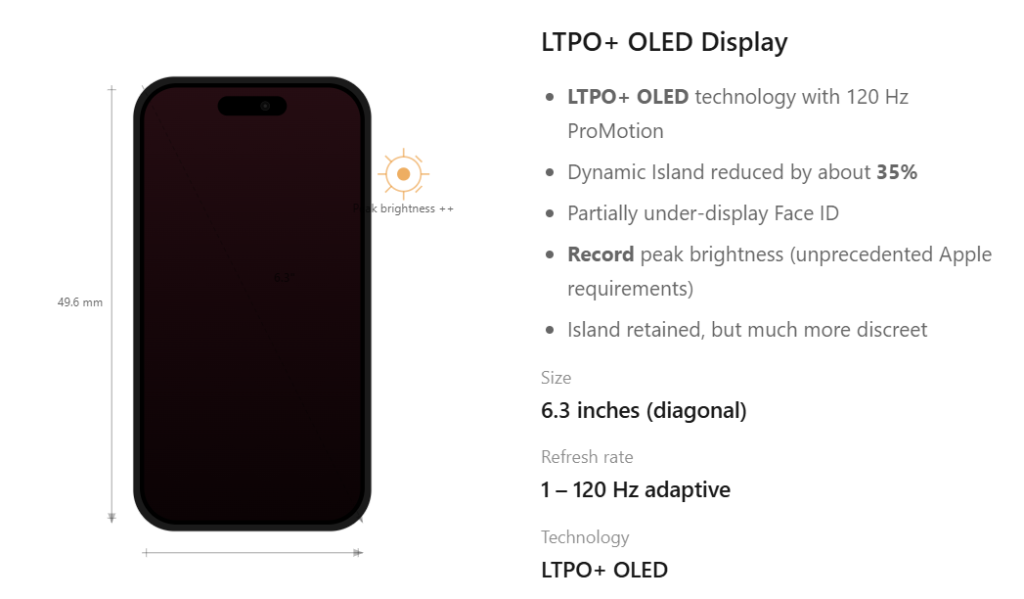
A completely under-display Face ID system has not been confirmed. It remains a long-term possibility for future iPhones but is not expected for the iPhone 18 generation.
One supplier report indicates Apple has set unprecedentedly high brightness requirements for the iPhone 18 display, which at least one supplier is reportedly struggling to meet. Whether this results in a higher peak brightness than the iPhone 17 Pro is unknown.
The Camera: Variable Aperture
The most significant camera rumor for the iPhone 18 Pro is a variable aperture lens on the main camera. This would mean the lens physically adjusts the size of the opening to control how much light reaches the sensor. Samsung and Xiaomi have both attempted variable aperture on smartphones with mixed results. Whether Apple’s implementation succeeds where others have faltered remains to be seen.
The main sensor is expected to remain 48MP. The front-facing camera is rumored to upgrade to 24MP across all iPhone 18 models, up from 18MP on the iPhone 17.
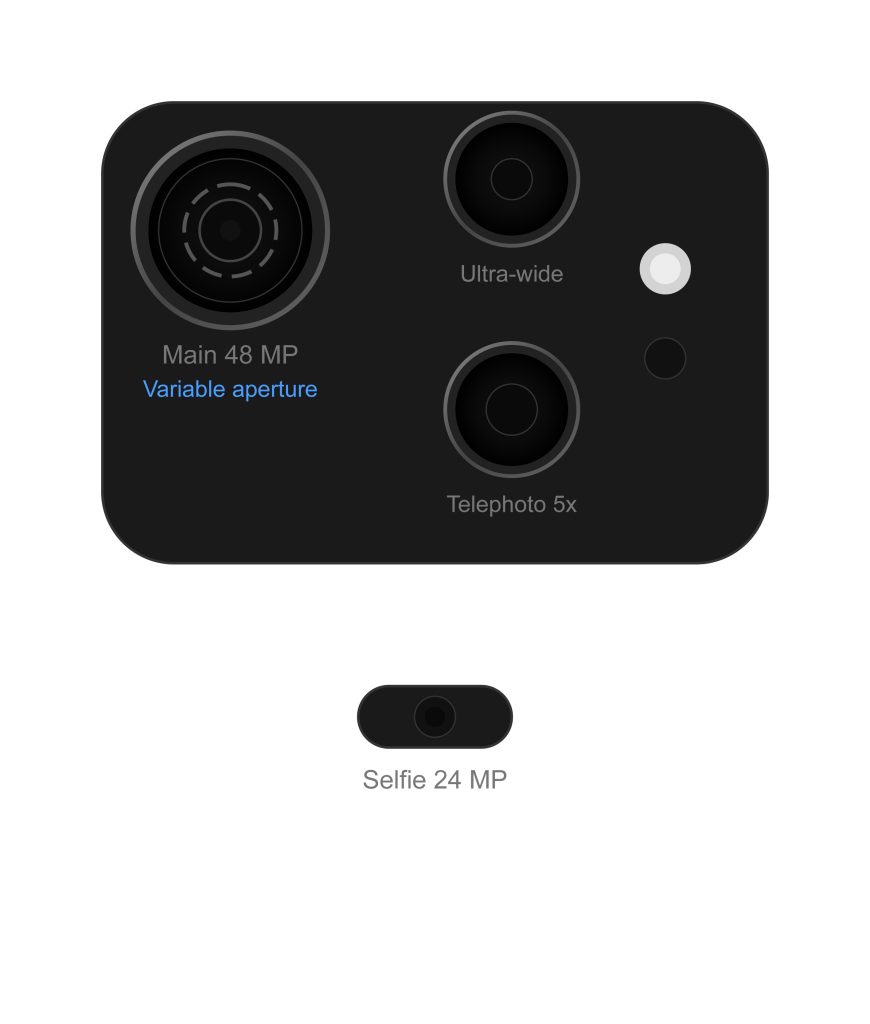
The Camera Control button, introduced on the iPhone 16, may be simplified on the iPhone 18. The current version uses both capacitive and pressure sensors for touch gestures and pressure levels. The next version could eliminate the capacitive sensing layer, using pressure sensing for all functions instead. This would reduce manufacturing cost and complexity.
Battery: Larger, But How Much Larger?
Battery capacity rumors for the iPhone 18 Pro are inconsistent. Leaker Digital Chat Station on Weibo reported that Pro model batteries could exceed 5,000mAh, which would be an improvement over the iPhone 17 Pro. A separate leak from the same source suggested Apple is testing different capacities for China and U.S. versions, with the Chinese model at 4,056mAh and the U.S. model at 4,288mAh. These figures are similar to the iPhone 17 Pro and do not represent a major increase.
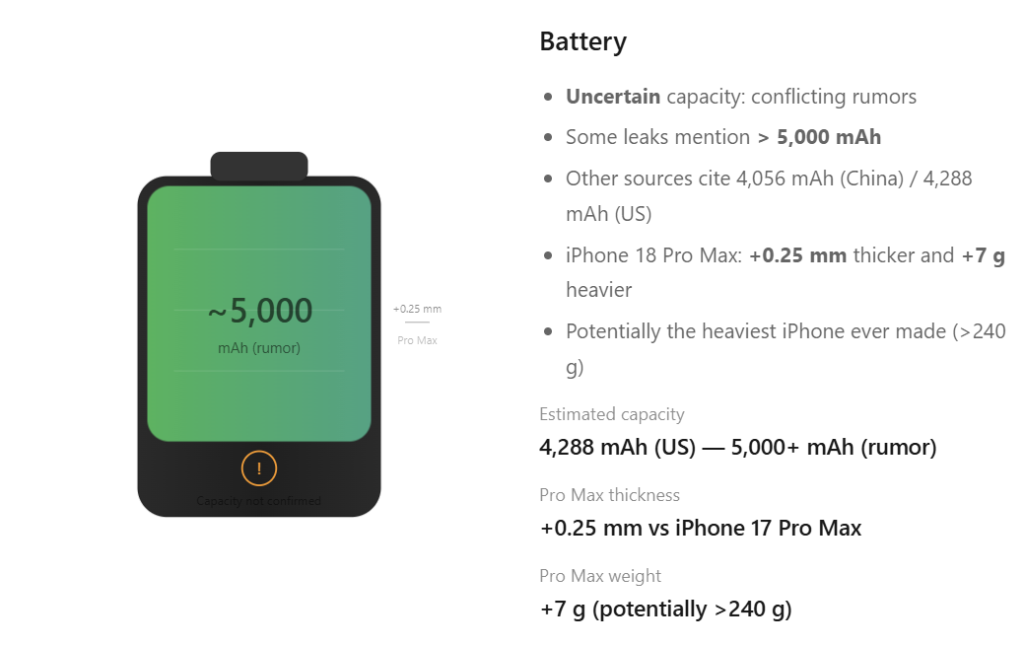
The iPhone 18 Pro Max is expected to be slightly thicker and heavier than its predecessor to accommodate a larger battery. Ice Universe claims the device will be 0.25mm thicker and 7 grams heavier, potentially making it the heaviest iPhone yet at over 240 grams.
The back glass may also be altered. Leaker Instant Digital claims the iPhone 18 Pro will have a unified back glass design, as opposed to the two-tone look of the iPhone 17 Pro. Whether this affects durability or is purely aesthetic is unknown.
Modem and Connectivity
The iPhone 18 Pro is expected to use Apple’s next-generation C2 modem. Current rumors suggest Apple will use a mix of its own C2 modems and Qualcomm modems across the iPhone 18 lineup, possibly using Qualcomm modems in the United States and C2 modems in other countries.
The C2 modem is expected to support mmWave 5G, but the fact that Apple may continue using some Qualcomm modems suggests the C2 may still have limitations. If it does not support mmWave, Apple would not be able to use it in the United States, where mmWave is deployed by major carriers.
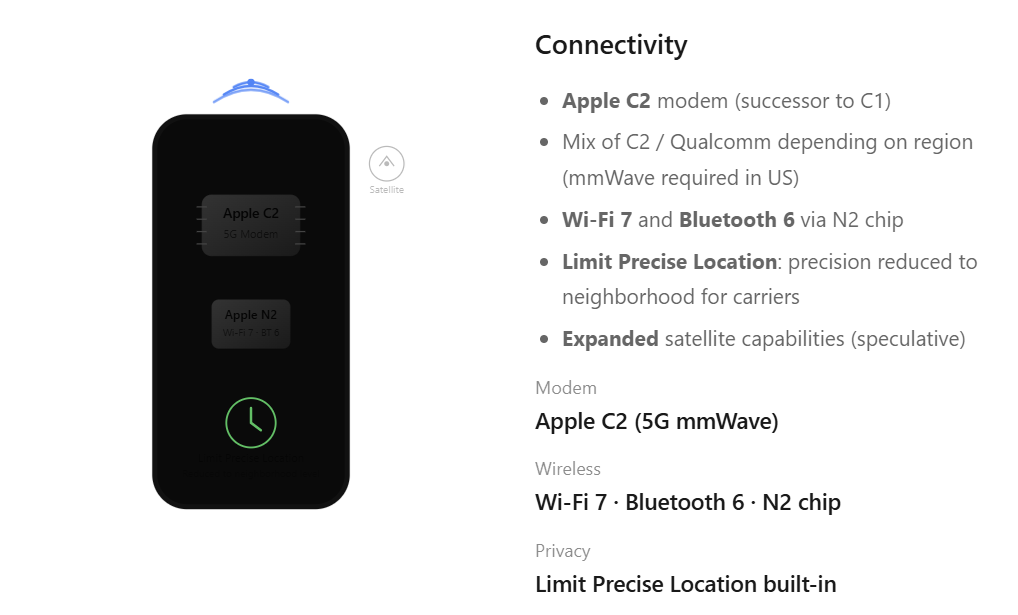
The C2 modem will include a privacy-focused Limit Precise Location setting that reduces the location data available to mobile networks. Instead of seeing location down to an address, carriers would see only the neighborhood. This feature is already available on the iPhone 17e with the C1X modem but not on iPhone 17 models with Qualcomm modems.
The iPhone 18 Pro is also rumored to include a new N2 chip for Wi-Fi and Bluetooth, supporting Wi-Fi 7 and Bluetooth 6. Some reports have mentioned expanded satellite capabilities beyond Emergency SOS, although these claims remain speculative and have not been corroborated by multiple independent sources.
What the iPhone 18 Pro Does Not Have
Based on current rumors, the iPhone 18 Pro will not feature a radical redesign. The iPhone 17 Pro introduced a major visual overhaul with the camera plateau and two-toned color scheme. Apple is expected to retain that design for at least one more generation.
The device is not expected to include a periscope telephoto with optical zoom beyond the current 5x. Apple reserved that feature for the Pro Max starting with the iPhone 15 generation, and there are no credible rumors of it coming to the smaller Pro model.
There is no indication that Apple will reintroduce Touch ID on the iPhone 18 Pro. The rumored foldable iPhone may use Touch ID instead of Face ID due to space constraints, but the Pro models are expected to retain Face ID exclusively.
The iPhone 18 Pro will not have a headphone jack. This has been the case since the iPhone 7 and is not expected to change.
The Foldable iPhone: What We Know
Apple’s first foldable, referred to as either iPhone Fold or iPhone Ultra, is expected to launch alongside the iPhone 18 Pro in September 2026. Early reports suggested a December delay, but more recent supply-chain evidence, including component shipments already underway, points to an on-time September launch.
The foldable is rumored to have a 5.5-inch outer display and a 7.8-inch inner display with a 4:3 aspect ratio. It is expected to use the A20 chip, not the A20 Pro. The device may use Touch ID instead of Face ID due to the thin profile when open, reportedly 4.5mm. A liquid metal hinge and vapor chamber cooling have been mentioned in leaks. The starting price is expected to exceed $2,000.
Colors and Pricing
Leaked dummy models and analyst reports suggest the iPhone 18 Pro will come in light blue, dark cherry, dark gray, and silver. A black option is not expected to return. The back Ceramic Shield area may receive a frosted finish.
Pricing is where uncertainty is highest. Several analysts expect iPhone 18 Pro pricing to increase because of rising component costs and ongoing memory supply constraints. Apple has not commented on future pricing. The Journal estimated the iPhone 18 Pro could start at $1,299, a $200 increase over the iPhone 17 Pro’s $1,099 starting price. Some analysts believe rising memory prices could increase production costs, although the exact impact remains unknown.
In the UK, analyst estimates currently center around £1,199 for the 256GB iPhone 18 Pro. However, pricing remains uncertain until Apple officially announces the lineup.
How It Compares to Samsung and Google
The iPhone 18 Pro’s most direct competitor is Samsung’s Galaxy S27 Ultra, expected in early 2027. Samsung typically emphasizes larger batteries, higher RAM capacities, and more versatile camera hardware, while Apple has historically focused on chip efficiency, software optimization, and ecosystem integration. Apple’s advantage has historically been chip efficiency, software optimization, and ecosystem integration.
Google’s Pixel 10 Pro, also expected in 2027, competes on computational photography and AI features. Google’s Tensor chips have not matched Apple’s A-series in raw performance, but Pixel phones often lead in software-driven camera capabilities and on-device AI.
The comparison that matters most for the iPhone 18 Pro is not against Android flagships but against the iPhone 17 Pro. The rumored upgrades, variable aperture, smaller Dynamic Island, A20 Pro chip, and potentially larger battery, are incremental rather than transformative. For iPhone 17 Pro owners, the upgrade case is weak unless you need one of those specific features. For iPhone 15 Pro or older users, the cumulative improvements across two or three generations are more substantial.
Bottom Line
The iPhone 18 Pro is shaping up to be an incremental upgrade over the iPhone 17 Pro, not a generational leap. The A20 Pro chip, variable aperture camera, and smaller Dynamic Island would represent meaningful improvements if current rumors prove accurate. But the design is expected to remain largely unchanged, the RAM stays at 12GB, and the battery increase is uncertain.
The possibility of a price increase has been widely discussed by analysts, but Apple has not confirmed future pricing. If the iPhone 18 Pro starts at $1,299, it will be the most expensive base-model Pro iPhone Apple has released. Whether the hardware improvements justify that cost depends on which features you value.
For buyers deciding between the iPhone 18 Pro and waiting for the standard iPhone 18 in spring 2027, the choice is simple. If you need a new phone in 2026, the Pro is the only option. If you can wait, the standard iPhone 18 will be cheaper but will lack the Pro’s camera, chip, and display features. The 9GB RAM limit on the standard model also means it will not support some on-device AI functions that the Pro handles locally.
All of this remains speculative until Apple announces the device, most likely on September 9, 2026.
Sources and further reading
- Bloomberg / Mark Gurman: Split launch timeline, foldable iPhone release window. Confidence level: HIGH.
- MacRumors: A20 chip details, RAM specifications, Dynamic Island rumors, modem information. Confidence level: HIGH.
- The Wall Street Journal: Analysis of Apple’s supply chain, semiconductor costs, and industry pricing trends. Confidence level: HIGH.
- Mashable: Pricing analysis, RAMageddon context, iPhone 18 Pro feature roundup. Confidence level: MEDIUM.
- CNET: Release timeline, iOS 27 features, foldable iPhone details. Confidence level: MEDIUM.
- PCMag: Design rumors, color options, camera control changes. Confidence level: MEDIUM.
- Ice Universe (Weibo): Smaller Dynamic Island dimensions, battery and weight changes. Confidence level: MEDIUM.
- Digital Chat Station (Weibo): Battery capacity tests, back glass design changes. Confidence level: MEDIUM.
About This Article
This article was compiled on July 24, 2026. Apple has not officially announced the iPhone 18 Pro. All specifications, pricing, and features are based on analyst forecasts, supply-chain reports, regulatory filings, and credible leaks. Where information is conflicting or unconfirmed, this article notes the uncertainty. Final details may change before Apple’s official announcement.
OFOKI TECH | Compiled July 24, 2026 | iPhone 18 Pro not yet officially announced