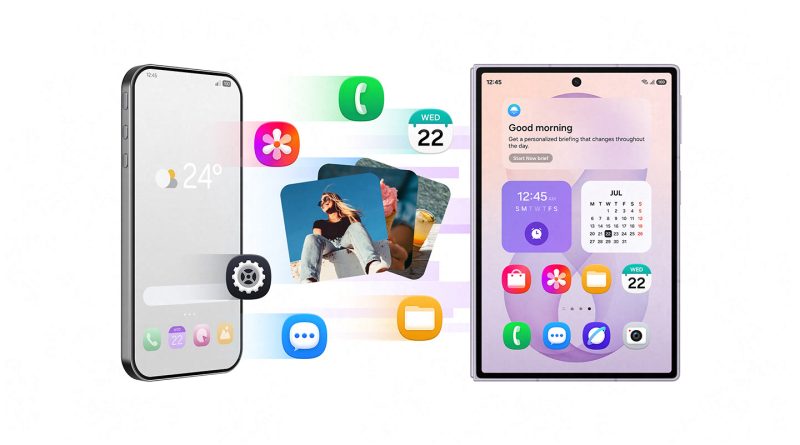
Samsung Galaxy Z Fold8 Ultra: The $2,100 Foldable That Brings Tablet Screens to Your Pocket
By OFOKI TECH | July 22, 2026
Samsung announced the Galaxy Z Fold8 Ultra today, July 22, 2026, at a Galaxy Unpacked event in London. The device is the successor to the Z Fold7, which has been Samsung’s flagship foldable since its launch in July 2025. But the Z Fold8 Ultra is not a modest upgrade. It is the first time Samsung has applied the « Ultra » designation to its foldable line, a label previously reserved for the Galaxy S series. The Z Fold8 Ultra starts at $2,099.99, a $100 increase over the Z Fold7. Preorders opened the same day. Retail availability is August 7.
This article breaks down what the Z Fold8 Ultra offers, what it does not offer, and how it positions itself against the standard Z Fold8, Google’s Pixel Fold 3, and Honor’s Magic V4.
The Display: Why 8 Inches Is the Right Number
The Z Fold8 Ultra features an 8-inch LTPO AMOLED inner display with a 120Hz refresh rate. The cover screen is a 6.5-inch AMOLED panel, also at 120Hz. Samsung claims up to 3,000 nits of peak brightness on the main screen, with Vision Booster and a low-reflection coating for outdoor visibility.
In an era where standard smartphones top out at 6.9 inches, 8 inches sounds modest. But screen size is not the point in isolation. The Z Fold8 Ultra is a foldable, and foldables prioritize the ratio of unfolded screen area to folded pocketability. The device measures 158.4 x 143.2 x 4.1 mm when unfolded and features an 8-inch inner display. That is 0.4 inches larger than the Z Fold7’s 7.6-inch panel, and the increase changes how the device handles multitasking. Samsung’s One UI 9 allows three apps to run side by side on the inner screen, and the 8-inch panel provides enough horizontal space for each app to remain usable without excessive scaling.
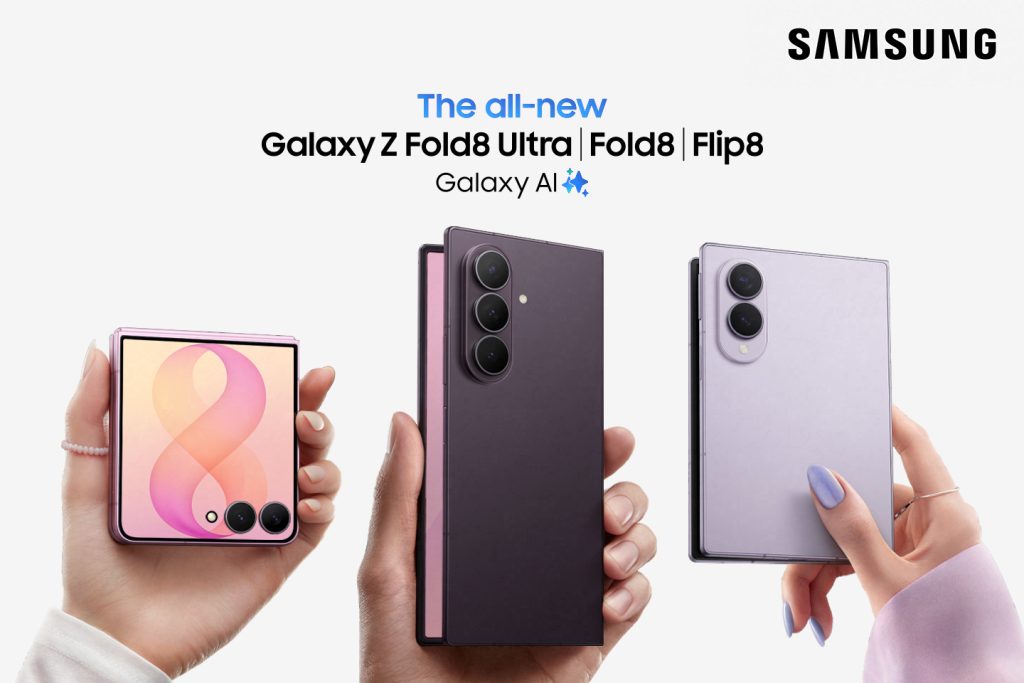
The aspect ratio is 4.3:3 on the inner display and 21:9 on the cover screen. The 4.3:3 ratio is closer to a tablet than a phone. Samsung designed the Z Fold8 Ultra for users who want a tablet experience in a pocketable form factor. The standard Z Fold8, by contrast, has a wider, shorter body with a 5.5-inch cover screen and a 7.6-inch inner display at a 4:3 aspect ratio. The standard model feels more like a traditional phone when folded. The Ultra feels more like a tablet when unfolded.
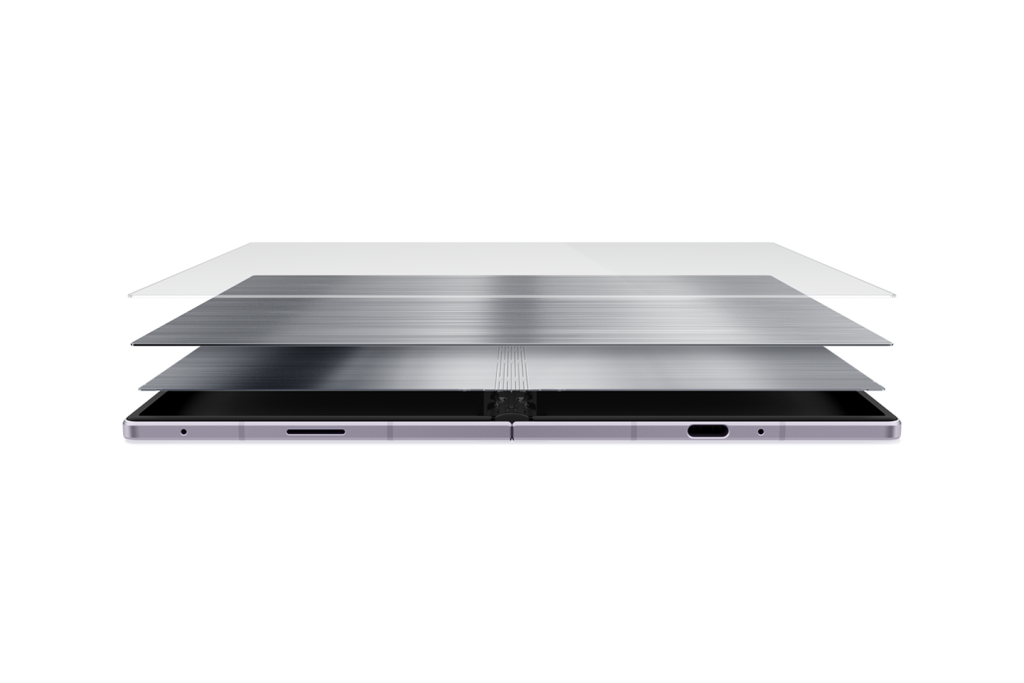
Samsung introduced a new technology called Flex Titanium into the display structure. The company says it uses a titanium-alloy film and an enhanced titanium plate to strengthen the display, improve durability, and help reduce crease visibility compared with previous generations. Samsung also says the hinge mechanics, display tension, and magnetic force have been refined to provide a smoother unfolding experience.
The crease remains visible under direct light. Flex Titanium reduces its prominence, but it does not eliminate it. This is a physical limitation of the foldable form factor that no manufacturer has solved.
The device is rated IP48 for water resistance, meaning it can withstand submersion in up to 1.5 meters of freshwater for 30 minutes. Samsung does not recommend use at the beach or in pools.
The Camera: 200MP on a Foldable
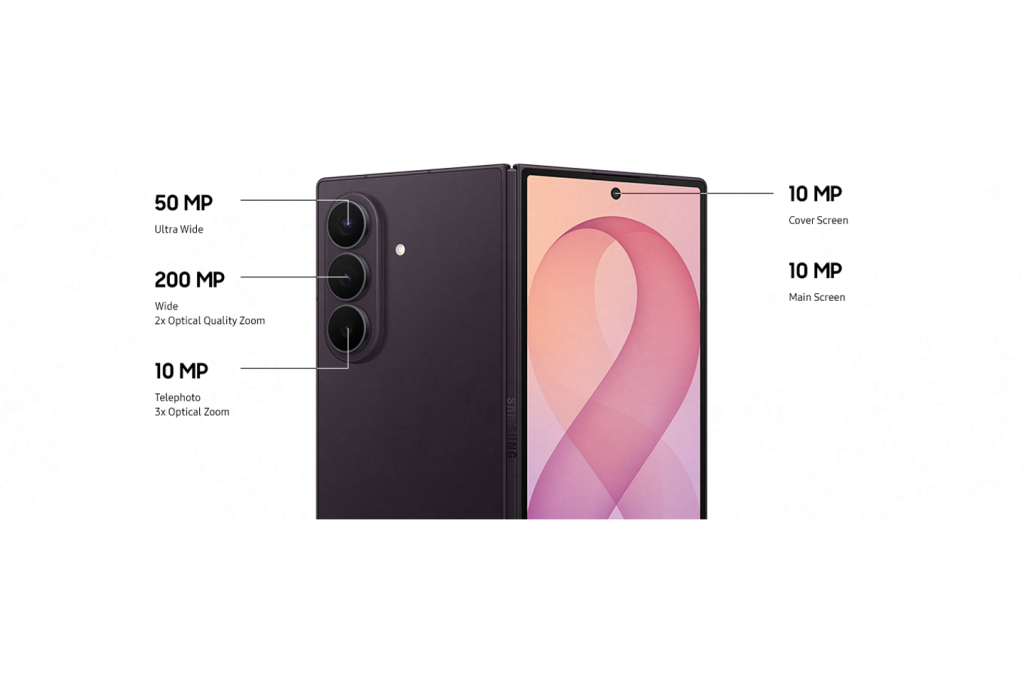
The rear camera array consists of a 200MP main sensor, a 50MP ultrawide lens, and a 10MP telephoto with 3x optical zoom. The 50MP ultrawide is an upgrade from the 12MP ultrawide on the Z Fold7. Samsung added HDR capability to the 200MP mode, which was absent on the Z Fold7. The device can record 8K video through a new APV codec, and includes a Cine LUT feature for color grading. Two 10MP selfie cameras sit on the cover and inner displays.
The 200MP main sensor is the same unit found in the Galaxy S26 Ultra. It uses pixel binning to produce 12.5MP images by default, combining 16 pixels into one for improved low-light performance. In bright conditions, users can switch to the full 200MP mode for maximum detail. The HDR addition to 200MP mode addresses a limitation of the Z Fold7, where high-resolution shots lacked the dynamic range of standard-resolution captures.
The 10MP telephoto with 3x optical zoom is unchanged from the Z Fold7. Samsung did not include a periscope telephoto with 5x or 10x zoom, a feature available on the Galaxy S26 Ultra. The reason is space. The Z Fold8 Ultra’s internal components, hinge mechanism, and dual batteries leave limited room for a periscope lens assembly. For users who need long-range zoom, the S26 Ultra remains the better choice.
The Cine LUT feature allows users to apply lookup tables for color grading directly in the camera app. This is a workflow feature borrowed from Samsung’s professional video division. It does not replace a dedicated color grading suite in post-production, but it allows creators to preview graded looks on set without exporting footage to a computer.
Performance and Battery: A 5,000mAh Cell in a Foldable
The Z Fold8 Ultra runs on the Snapdragon 8 Elite Gen 5 for Galaxy, an overclocked variant of Qualcomm’s chip. RAM options are 12GB or 16GB. The 16GB tier is paired exclusively with the 1TB storage option. Storage comes in 256GB, 512GB, or 1TB. There is no microSD card slot.
The device ships with One UI 9, based on Android 17. Samsung has committed to seven years of OS updates, matching the support window of the Galaxy S26 series. This is an increase from the five years of updates Samsung offered on the Z Fold6.
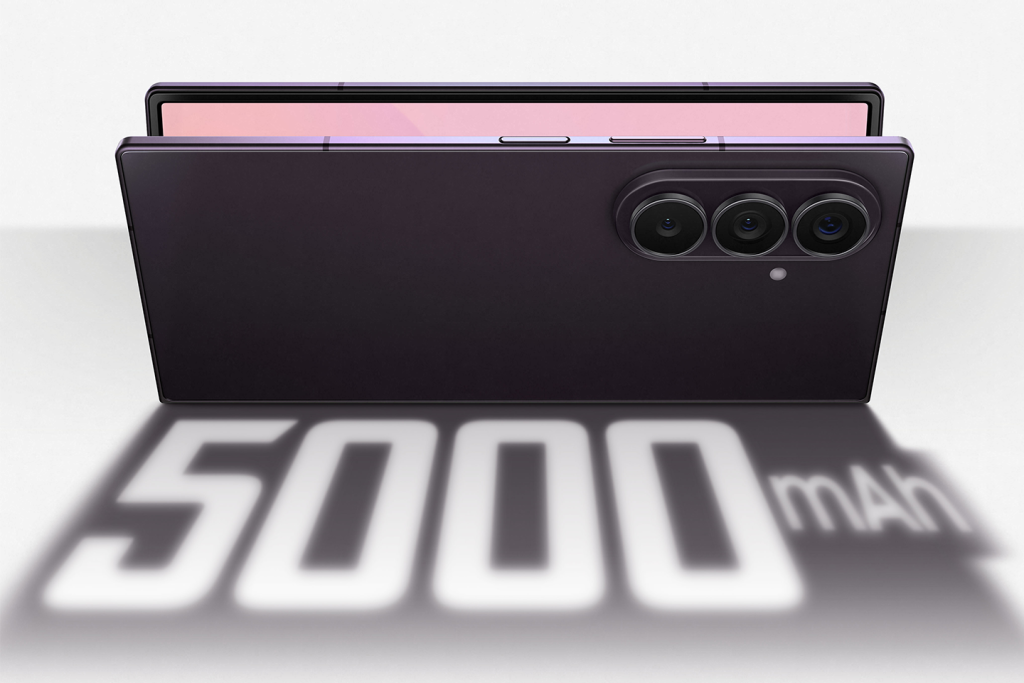
The battery capacity is 5,000mAh, up from 4,400mAh on the Z Fold7. Samsung attributes the increase to a silicon-carbon battery cell, a technology that allows higher energy density in the same physical volume. Wired charging tops out at 45W, wireless at 20W. The device also supports Wireless PowerShare for reverse charging of accessories.
Samsung says the charging system and thermal management have been improved to reduce heat generation during charging and help preserve long-term battery health. An expanded graphite cooling structure is included for thermal management, although Samsung has not publicly detailed the underlying charging architecture. The Snapdragon 8 Elite Gen 5 is a powerful chip, and sustained performance in foldables has been a recurring issue due to thermal constraints in the thin chassis. The expanded cooling is Samsung’s response.
In practice, the 5,000mAh battery should deliver a full day of use for most users. The 8-inch display is power-hungry, but the LTPO panel can drop to 1Hz during static content, and the silicon-carbon cell provides more capacity than the previous generation. Heavy users who run multiple apps on the inner screen simultaneously will still need to charge before the end of the day.
What the Z Fold8 Ultra Does Not Have
Samsung made deliberate choices about what to exclude. The Z Fold8 Ultra has no S Pen slot built into the body. The S Pen is supported, but it must be carried separately or stored in a case. The Galaxy S26 Ultra has a dedicated S Pen silo. The Z Fold8 Ultra does not, because the internal space is occupied by the hinge, the dual batteries, and the cooling system. Users who want integrated stylus storage must buy the S26 Ultra or carry the S Pen in a case.
The device has no headphone jack. This is standard for Samsung’s flagship line, but it is worth noting for users who prefer wired audio. The USB-C port supports audio output, and the device is compatible with Samsung’s Galaxy Buds series and third-party Bluetooth headphones.
There is no satellite connectivity for emergency messaging, a feature Apple introduced with the iPhone 14 and Google added to the Pixel 9 series. Samsung has not implemented satellite SOS on any of its devices. The company has stated that satellite connectivity is not a priority for its user base, which is concentrated in urban and suburban areas with reliable cellular coverage.
The Z Fold8 Ultra does not support expandable storage. The 1TB option is the maximum. For users who need more than 1TB of local storage, cloud services or external drives are the only options. This is a limitation shared with the iPhone and the Pixel, but it is a step back from Samsung’s earlier devices, which included microSD slots.
The Standard Z Fold8: A Different Product Entirely
Samsung launched two Z Fold models this year. Alongside the Z Fold8 Ultra, the company introduced the standard Z Fold8, which starts at $1,899.99, $200 below the Ultra. The standard Z Fold8 features a wider, shorter form factor with a 5.5-inch cover screen and a 7.6-inch inner display at a 4:3 aspect ratio. The Ultra retains the traditional tall, narrow cover screen and square inner display that has defined the line since its inception.
The standard Z Fold8 uses the same Snapdragon 8 Elite Gen 5 processor and the same 5,000mAh battery. Its camera system is a 50MP main sensor, a 12MP ultrawide, and a 10MP telephoto with 3x zoom. It does not have the 200MP main sensor or the 50MP ultrawide of the Ultra. It also lacks the Flex Titanium display structure and the Cine LUT video feature.
The choice between the two models comes down to screen size and camera quality. The Ultra is for users who want the largest possible foldable display and the best camera system Samsung offers in a foldable. The standard Z Fold8 is for users who want a foldable that feels more like a traditional phone when closed. The $200 price difference is smaller than the gap between the Galaxy S26 and S26 Ultra, which suggests Samsung expects significant crossover between the two foldable models.
How It Compares to Google and Honor
Google’s Pixel Fold 3, launched in May 2026, is the Z Fold8 Ultra’s most direct competitor in the North American market. The Pixel Fold 3 starts at $1,799, $300 less than the Z Fold8 Ultra. It features a 7.9-inch inner display, a Tensor G5 processor, and a camera system headlined by a 50MP main sensor. Google’s strength is computational photography and AI integration, including real-time translation and on-device image processing. Samsung’s strength is hardware: the larger screen, the 200MP camera, and the more powerful Snapdragon chip.
Honor’s Magic V4, available in Europe and Asia but not North America, starts at approximately $1,500. It is among the thinnest and lightest foldables currently available and competes primarily on design and price. The Magic V4 uses a Snapdragon 8 Elite Gen 4, the previous generation chip, and its camera system is competitive. Honor competes on price and form factor, while Samsung emphasizes ecosystem integration, camera hardware, and long-term software support.
The comparison that matters most is the Z Fold8 Ultra versus the Pixel Fold 3. Both are available in the same markets. Both run Android. The Pixel Fold 3 is less expensive and emphasizes Google’s AI ecosystem and computational photography. The Z Fold8 Ultra offers a larger display, more powerful camera hardware, and longer software support. The better choice depends on whether users prioritize Google’s AI features or Samsung’s hardware and ecosystem.
Pricing and Availability
The Z Fold8 Ultra starts at $2,099.99 for the 256GB model. The 512GB model costs $2,249.99. The 1TB model costs $2,549.99. Color options include Violet Shadow, Graphite, Cream, and Green Shadow. The Green Shadow variant is exclusive to Samsung.com.
Preorders include a storage upgrade at no extra cost (256GB to 512GB, or 512GB to 1TB) and a $200 Samsung Credit. The device is available through Samsung’s website, carrier stores, and major retailers. Carrier financing plans are available through Verizon, AT&T, and T-Mobile in the United States.
Bottom Line
The Samsung Galaxy Z Fold8 Ultra is the most capable foldable Samsung has released. It brings three features that were previously unavailable in a Z Fold: an 8-inch inner display, a 200MP camera system, and a 5,000mAh battery with silicon-carbon technology. The seven-year update commitment addresses a long-standing criticism of Samsung’s foldable line.
The omissions are deliberate. No S Pen slot, no headphone jack, no satellite connectivity, and no expandable storage keep the device focused on its core purpose while protecting Samsung’s other product lines. For users who want the largest possible screen in a pocketable device, the Z Fold8 Ultra sets a new benchmark within Samsung’s foldable lineup and is among the most capable foldables currently available.
For existing Z Fold7 owners, the upgrade decision depends on use case. If you need the larger screen, the improved camera, or the longer battery life, the Ultra is a clear jump. If you use your foldable primarily for email and media consumption, the Z Fold7 remains capable. For new buyers, the Z Fold8 Ultra is a compelling option over the Z Fold7. Samsung may continue selling the Z Fold7 in some markets while inventory lasts, although future availability has not been officially announced.
Sources and further reading
- Samsung Official: Product announcement, July 22, 2026. All specifications confirmed by Samsung’s press release and product page.
- TechRadar: Hands-on impressions and technical analysis published after Samsung’s official announcement.
- SamMobile: Pre-announcement reporting and leaks that were later consistent with Samsung’s official announcement.
- Android Police: Competitive analysis comparing Z Fold8 Ultra to Pixel Fold 3 and Honor Magic V4. Confidence level: CONFIRMED.
- GSMArena: Official retailer specifications, pricing, and availability. Confidence level: CONFIRMED.
About This Article
This article was compiled on July 22, 2026, the day of Samsung’s official Z Fold8 Ultra announcement. All specifications are drawn from Samsung’s official press materials, confirmed retailer listings, and verified technical publications. Specifications are based on Samsung’s official announcement. Comparative analysis and buying recommendations reflect editorial evaluation. Pricing and availability are subject to regional variation.
OFOKI TECH | Compiled July 22, 2026 | Samsung Galaxy Z Fold8 Ultra officially announced today