DARPA and U.S. Air Force Fly AI-Controlled F-16 in First VENOM Test Flights
By OFOKI TECH | August 11, 2026
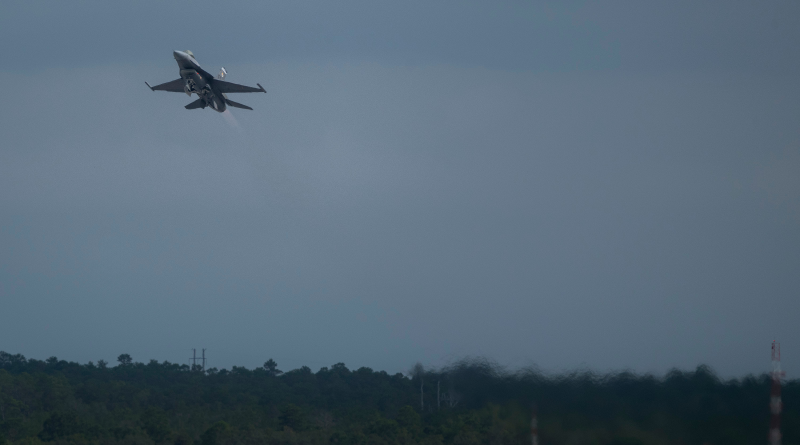
In July 2026, a U.S. Air Force F-16 fighter jet modified with the Viper Experimentation and Next-generation Operations Model (VENOM) Autonomy Kit took to the skies over Eglin Air Force Base, Florida, with an artificial intelligence agent controlling the aircraft. The flights represent the first time an AI has autonomously piloted a standard operational F-16 in real-world conditions, building on earlier DARPA work with the specialized X-62A VISTA test aircraft. The program is a joint effort between the Air Force and DARPA, initiated under the Air Combat Evolution (ACE) program.
From Simulation to Real Aircraft
The VENOM program began converting F-16s into autonomous-capable test platforms in 2024. Three F-16C/D aircraft arrived at Eglin in 2024 and 2025 to be rebuilt under the VENOM-AFT (Autonomy Flying Testbed) initiative, operated by the 96th Test Wing and the 53rd Wing. The jets underwent extensive modification to accept the VENOM Autonomy Kit (VAK), which connects to the aircraft’s flight controls and mission systems without altering the F-16’s core software.
The aircraft began flying again in June 2026 to verify airworthiness after the modifications. In July, the team conducted the first flights where an AI agent took control in the air, with the human pilot on board shifting from active pilot to supervisor. This is distinct from a drone conversion: the pilot remains in the cockpit throughout, but control of the aircraft can be handed to the AI for specific test points.
Human-on-the-Loop
The Air Force has emphasized that the human pilot never leaves the loop. The VENOM kit allows the pilot to toggle between traditional human control and AI control with the flip of a switch. This « human-on-the-loop » approach means the pilot monitors the AI’s decisions and can intervene at any time. Col. Joe Gagnon, commander of the 85th Test and Evaluation Squadron, has stated that there will never be a time these VENOM aircraft fly solely by themselves.
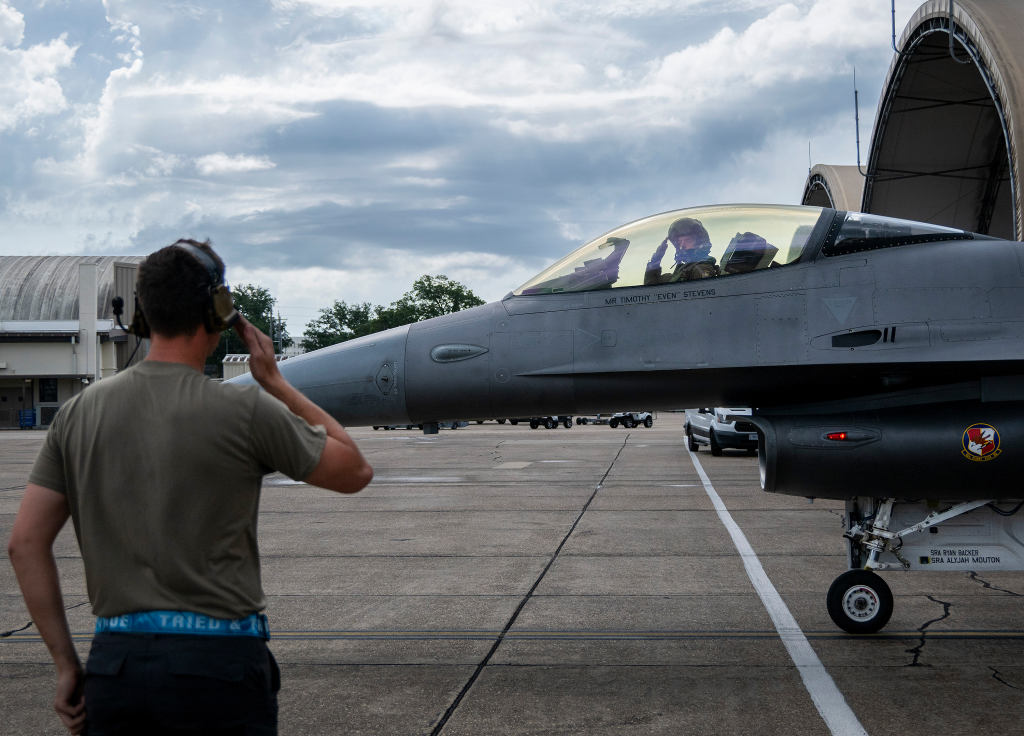
The safety architecture is deliberate. The faster the Air Force can validate that an autonomy behavior is safe on a crewed F-16, the faster that same software can be trusted for uncrewed applications. The goal, as described by test leadership, is « speed-to-ramp »: moving as quickly as safety allows to prepare the software for future autonomous platforms.
The ACE Program Foundation
VENOM builds directly on DARPA’s Air Combat Evolution program, which achieved the first-ever in-air tests of AI algorithms autonomously flying an F-16 against a human-piloted F-16 in 2023 and 2024. Those earlier tests used the X-62A VISTA, a specially modified two-seat F-16D that can simulate the flight characteristics of various aircraft types. In September 2023, the ACE program conducted the first AI-vs-human dogfight, with the AI-controlled VISTA engaging a manned F-16 in within-visual-range combat.
The VENOM program takes that proof of concept and applies it to standard operational F-16s. Where VISTA is a unique, hand-built test aircraft, VENOM is designed to be a repeatable, scalable testbed. The lessons learned from how an AI handles formation flying, combat maneuvers, and weapons passes in a VENOM F-16 will feed directly into the software that powers future autonomous systems.
Connection to Collaborative Combat Aircraft
The VENOM flights are not an end in themselves. They are a stepping stone toward the Air Force’s Collaborative Combat Aircraft program, which aims to field fleets of semi-autonomous drone wingmen that fly alongside crewed fighters like the F-35 and the future F-47. The CCA program envisions cheap, attritable drones that can be directed by a human pilot but fly and fight autonomously within defined parameters.
The VENOM fleet will serve as the cornerstone for the next phase of AI development under DARPA’s Artificial Intelligence Reinforcements (AIR) program. AIR will use the VENOM aircraft to test multiple AI agents in live-flight scenarios, scaling from single-ship tests to multi-ship operations with increased complexity. The program aims to develop autonomy for beyond-visual-range, multi-aircraft combat.
What Comes Next
Brig. Gen. James Valpiani, the DARPA program manager who oversaw the VENOM milestone, is concluding his tenure this month. Lt. Col. Patrick Highland has joined DARPA as the incoming program manager for AIR. Terry Wilson, director of AI Development and Transition for the Air Force Research Laboratory’s Autonomy Capability Team, remains as deputy program manager for both VENOM and AIR, ensuring continuity across the transition.
The AIR program will continue to expand the scope of testing, moving from single-aircraft autonomy to multi-ship operations. The long-term goal is to enable human pilots to command and orchestrate teams of autonomous aircraft, with the AI handling tactical maneuvering while the human maintains strategic oversight.
Sources and further reading
- DARPA: DARPA, U.S. Air Force fly AI-controlled F-16
- DARPA: ACE program timeline
- MigFlug: DARPA’s AI Just Flew a Real F-16
- Military Embedded Systems: AI-controlled F-16 begins autonomous flight testing
- AFMC: VENOM program progresses to piloted flights
- DARPA: ACE Program Achieves World First for AI in Aerospace