White House Accuses Moonshot AI of Distilling Anthropic’s Fable to Build Kimi K3: What We Know and What We Don’t
By OFOKI TECH | July 24, 2026
A top White House official has publicly accused Moonshot AI of using distillation to reproduce capabilities from Anthropic’s Fable model during the development of Kimi K3. The accusation, made on July 22 without public evidence, escalates the debate over how Chinese AI labs are building competitive open-source models and whether the US government will respond with sanctions.
What the White House Alleged
Michael Kratsios, director of the White House Office of Science and Technology Policy, wrote on X that the administration « has information » Moonshot AI distilled Anthropic’s Fable for Kimi K3. He claimed the Chinese startup built a « sophisticated internal platform » to conduct large-scale distillation against US models while switching access methods to avoid detection.
Kratsios distinguished between legitimate distillation — a common practice in AI development — and what he called « large-scale, covert industrial distillation aimed at stealing proprietary US technology and undermining American research. » He did not provide documentation, technical evidence, or independent verification to support the claim.
The statement is the most direct accusation yet from the US government against a Chinese AI lab. It comes as Kimi K3 has been widely regarded as one of the most capable open-source AI models released to date, matching or exceeding the performance of leading US frontier models on several benchmarks.
What Is Distillation
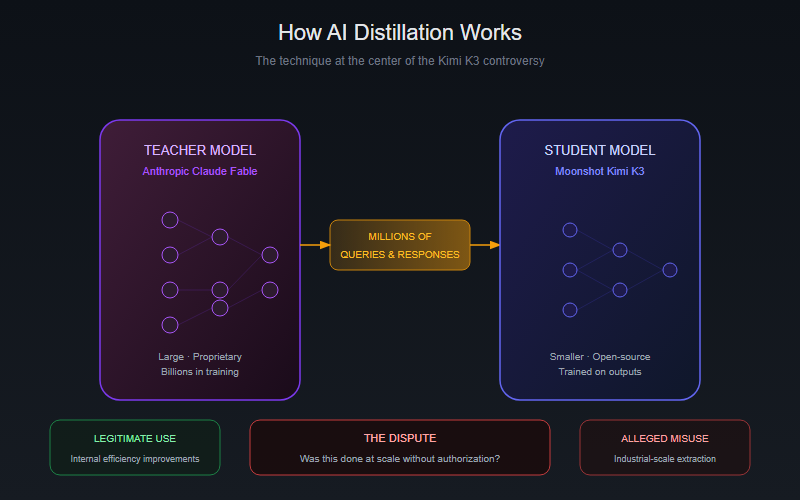
Distillation is a standard technique in machine learning where a smaller model is trained to mimic the outputs of a larger, more capable model. AI labs, including Anthropic itself, use distillation routinely to create efficient versions of their flagship systems.
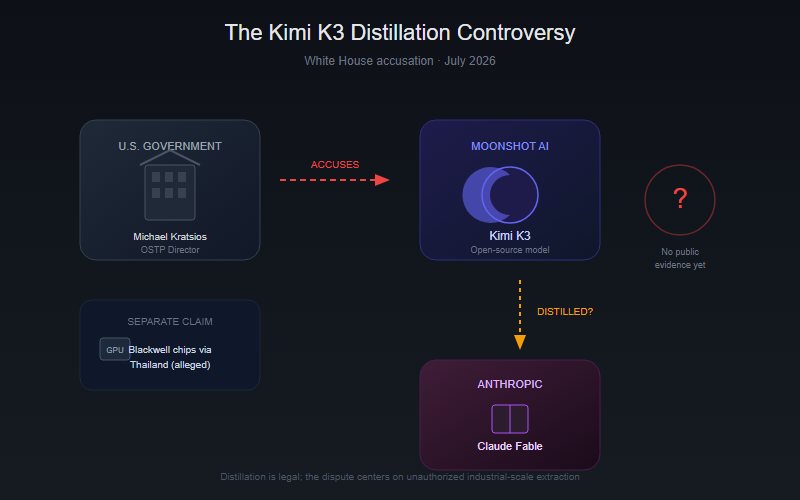
The technique is not illegal. It is taught in universities, documented in open research papers, and used commercially. The controversy arises when distillation is conducted without authorization, at industrial scale, and against a competitor’s terms of service. Whether Moonshot AI violated any specific law or contractual obligation remains unresolved.
What Anthropic Had Already Said
The White House accusation builds on earlier claims from Anthropic. In February 2026, Anthropic accused Moonshot, DeepSeek, and MiniMax of using distillation to extract capabilities from its Claude chatbot. Anthropic alleged that Moonshot used approximately 24,000 fraudulent accounts involved in more than 16 million exchanges with Claude to extract reasoning and coding capabilities.
Anthropic’s head of public policy, Sarah Heck, supported the White House position following Kratsios’ statement, calling illicit distillation « IP theft and industrial espionage that supports adversary military and intelligence capabilities. » Moonshot AI has not publicly responded to either Anthropic’s February accusations or the White House’s July statement.
The Evidence Question
Whether distillation occurred, and whether it violated any specific rule, remains unproven in public. Several factors complicate the accusation.
Anthropic’s Fable was released roughly one week before Kimi K3. Some observers have questioned whether a distillation operation of the scale described by Kratsios could be completed in that timeframe, given that distillation typically requires extensive data collection, training runs, and evaluation.
Additionally, Kimi K3 is an open-weight model. Independent researchers can download and analyze its architecture and weights. No independent technical audit has publicly confirmed that Kimi K3 contains distilled components from Fable. The White House has not indicated when or if evidence will be presented.
The GPU Accusation
Kratsios also accused Moonshot of sourcing cutting-edge Nvidia Blackwell GPUs from Thailand, bypassing US export controls designed to prevent Chinese companies from acquiring advanced semiconductors. The claim, if true, would represent a separate violation of US trade restrictions.
Nvidia has faced scrutiny over how its chips reach China through third countries. The Thailand accusation adds Moonshot to a growing list of Chinese firms alleged to have circumvented controls through intermediary markets.
What Happens Now
Treasury Secretary Scott Bessent suggested last week that the US may sanction Chinese AI companies if improper distillation is proven. Kratsios’ statement appears to lay groundwork for that possibility, though no sanctions have been announced as of July 24.
The case tests the boundaries of what constitutes legitimate model training. Distillation is a standard technique used by US labs. The distinction between acceptable research practice and « covert industrial distillation » is not clearly defined in law or industry standards. If the US government moves to sanction Moonshot, it will need to establish either a legal violation or a new regulatory framework for AI model training.
The Open-Source Debate
The accusation arrives as the US government tightens restrictions on Chinese AI development. Export controls on advanced semiconductors have been expanded, and lawmakers have debated whether open-source models from China pose national security risks.
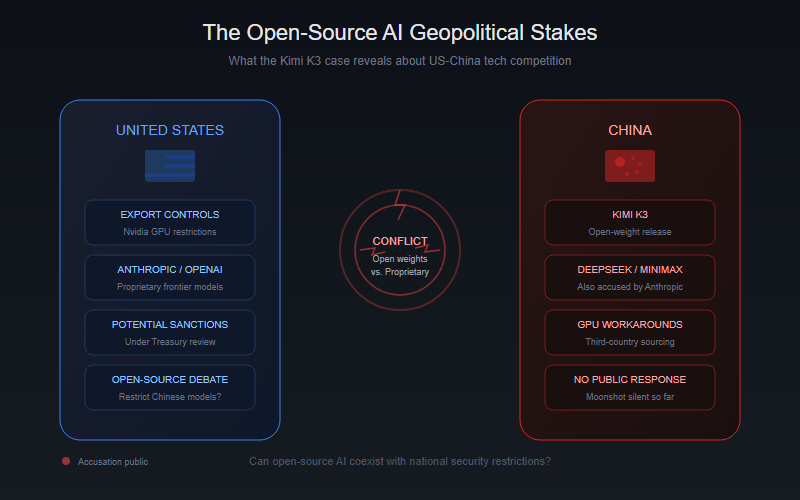
Kimi K3’s open-weight release means any developer can download, modify, and deploy the model locally. This has intensified competition between US and Chinese AI labs and raised questions about whether open-source models from adversarial nations should face usage restrictions within the US.
Bottom Line
The White House has made a serious accusation against Moonshot AI without presenting public evidence. Kimi K3’s capabilities are real and independently verifiable. Whether those capabilities were obtained through improper distillation is a claim that remains unsubstantiated.
For now, the situation is political as much as technical. The administration is signaling that it views Chinese open-source AI competition as a threat to US technological leadership. Whether that signal translates into concrete policy — sanctions, trade restrictions, or new regulations — depends on evidence that has not yet been made public.
Sources and further reading
- Business Insider: White House says Moonshot AI ‘distilled’ Fable to build Kimi K3. Kratsios statement, accusation of GPU sourcing from Thailand, context on Bessent sanctions threat.
- PCMag: China’s Kimi K3 AI Model Cheated by Cloning US Tech. Kratsios tweet, Anthropic February accusations, skepticism around Fable release timing.
- Reuters Connect: White House Accuses Chinese AI Firm of Stealing US Technology. Video coverage of the official accusation.
- South China Morning Post: Global AI experts push back on US ‘distillation’ claims against Moonshot’s Kimi K3 model. Technical skepticism and community response.